Keywords
humeral fractures - elbow - orthopedic pins - orthopedic wires - internal fixation
of fractures
Introduction
Humeral shaft fractures correspond to between 3 and 5% of the fractures in children < 16
years old. These lesions are more common in individuals < 3 years old or > 10 years
old.[1] The shaft region is involved in < 20% of the humeral fractures in children.[2]
On the other hand, radial distal third fractures are common in children.[3] They are significant when there is involvement of the growth plate and require caution
during management to prevent a reduction in the range of motion, as well as permanent
deformities.
Elbow dislocations account for 3% of all the dislocations in children. The incidence
is higher in the second decade of life, mainly between 13 and 14 years old; these
lesions are more common in boys than in girls, with a 2:1 ratio. The trauma mechanism
often results from falls with the hand in hyperextension and the elbow in a 30° flexion.
The simultaneous occurrence of fractures in one or two forearm bones and an ipsilateral
humeral shaft fracture is called floating elbow.[4] It represents 2% of the trauma lesions in children and normally results from high-energy
traumas.[5]
However, there were no reports in the searched literature, namely the PubMed, Lilacs
and Bireme databases, of the three concurrent, ipsilateral lesions (humeral shaft
fracture associated with elbow dislocation and fracture of the distal third of the
forearm bones) in the same patient.
Case Report
A 13-year-old boy with a history of a fall from a height of three meters was admitted
at a reference trauma hospital with pain, edema, deformity, and movement limitation
in the left arm. At the clinical examination, the patient was in good general conditions,
eupneic, responsive, and oriented to time and space. The affected limb presented no
distal radial pulse alterations. The neurological exam was unremarkable. The radiographic
exam revealed the diagnosis of an oblique humeral shaft fracture with a 2 cm shortening
and varus angulation associated with an ipsilateral posterior elbow dislocation, a
Salter Harris I epiphyseal dislocation of the distal third of the radius, and a greenstick
fracture of the distal third of the ulna ([Fig. 1]).
 Fig. 1 Fracture of the left humeral shaft (A); Left elbow dislocation (B); Left radial epiphyseal
lesion and greenstick fracture of the distal third of the left ulna (C).
Fig. 1 Fracture of the left humeral shaft (A); Left elbow dislocation (B); Left radial epiphyseal
lesion and greenstick fracture of the distal third of the left ulna (C).
The patient was submitted to closed manipulation of the elbow dislocation, of the
epiphysis dislocation, and of the ulnar greenstick fracture under anesthetic sedation,
with satisfactory reduction ([Fig. 2]). An antebrachiopalmar splint associated with a commercial Velpeau shoulder immobilizer
was used to treat the humeral shaft fracture with satisfactory reduction and alignment.
After 1 week, due to a deviation in the humeral fracture, the patient was submitted
to surgical treatment with retrograde flexible rods (Titanium Elastic Nail System;
Synthes, Solothurn, Switzerland), followed by the application of an antebrachiopalmar
cast and the use of a commercial Velpeau shoulder immobilizer ([Fig. 3]).
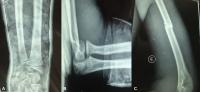 Fig. 2 Closed manipulation of the left distal radial epiphysis dislocation and the left
ulnar greenstick fracture (A); Closed manipulation of the left elbow dislocation (B);
Closed manipulation of the left humeral shaft fracture (C).
Fig. 2 Closed manipulation of the left distal radial epiphysis dislocation and the left
ulnar greenstick fracture (A); Closed manipulation of the left elbow dislocation (B);
Closed manipulation of the left humeral shaft fracture (C).
 Fig. 3 Profile and anteroposterior radiographs showing the adequate fixation with flexible
rods (A) and (B); fracture consolidation after 5 months (C).
Fig. 3 Profile and anteroposterior radiographs showing the adequate fixation with flexible
rods (A) and (B); fracture consolidation after 5 months (C).
Flexible rods were introduced with 2 cm access, one at a posterior transtriceps location
and the other posterolateral, between the triceps and biceps brachii, with the proper
protection of the soft parts. Two 2.5 mm-thick rods were introduced, configuring 80%
of the humeral medullary canal of the patient (6.25 mm); the angulation of each rod
was calculated at 30° with the apex at the fracture site.[2]
After the fixation with the rods, the elbow stability was evaluated by 30° and 60°
joint varus and valgus stress, with unremarkable results.
The patient was followed-up at an outpatient facility at 15 days, and at 1, 2, 3,
and 5 months. Anteroposterior and profile X-rays of the arm, of the elbow, and of
the wrist were taken at each visit; moreover, bone consolidation and joint functionality
were evaluated, as well as possible complications. The early movement for the gain
of the range of motion of the elbow started at the first week postoperative, but the
patient reported pain and difficulty to recover his range of motion due to the discomfort
at the entrance points of the rods. The antebrachiopalmar cast was removed at 5 weeks,
followed by exercises for the gain of range of motion and strengthening of the wrist.
At the 3rd month postprocedure, there was a cutaneous rash at the entrance point of the flexible
rods, resulting in exposure. After treatment with serial dressings, the healing was
complete. The introduction of the antegrade rod by the proximal lateral aspect of
the humerus might prevent this complication.
The rods were removed 5 months after the procedure. The boy is under outpatient follow-up
and motor rehabilitation. He presents loss of the last 5° of extension and flexion
of the elbow, fully preserved pronosupination, and complete range of motion of the
wrist with no pain or instability in the elbow, the wrist or the hand ([Fig. 4]).
 Fig. 4 Range of motion of the patient after losing 5° of flexion (A) and 5° of extension
(B).
Fig. 4 Range of motion of the patient after losing 5° of flexion (A) and 5° of extension
(B).
Discussion
The incidence of elbow dislocation in children is of between 3 and 6%; humeral shaft
fractures account for 5% of the total number of fractures in this group.[1]
[2]
[6] Approximately 15% of all fractures in children involve the physes. Radial distal
fractures, however, represent up to a third of all the pediatric fractures.[7] Twenty percent of these fractures involve the physeal zone of the distal third of
the radius.[2] Among distal radial physeal lesions, 58% are Salter Harris type II.[8]
Some studies associated two from these three lesions, often with the simultaneous
occurrence of fractures in one or both forearm bones and in the humeral shaft; this
lesion is called floating elbow, with an incidence of between 2 and 17%.[5]
[9] No reports were found in the searched literature describing the association of these
three lesions in the same patient.
The treatment of associated lesions must consider each injury to reestablish the anatomy,
the joint congruity, and the range of motion of the limb. In the reported case, the
closed manipulation of the elbow dislocation and the radial epiphysis dislocation
was performed and followed by the immobilization of the distal joint with an antebrachiopalmar
splint.[8] Most distal radial fractures in children can be treated without surgery due to the
higher bone remodeling ability. Radiographical and clinical criteria warranted the
nonsurgical treatment of this patient, including the frontal angulation of the fracture
of < 10° and the lack of a neurovascular lesion.[2]
The initial approach method for a humeral shaft fracture is supported by the literature.[10] The patient fulfilled the radiographical criteria that allowed the nonsurgical treatment,
including a varus deviation of < 30°, and an internal rotation of < 15°,[2] which characterize a stable fracture. However, after 1 week, the reduction was lost
and, then, we opted for the surgical treatment.
The use of flexible rods is indicated for the treatment of humeral shaft fractures.[2] Compared with the conservative treatment, the rods improve anatomical alignment,
reduce hospitalization time, enable a faster return to daily activities, and allow
an improved pain control.[10]


