Keywords
suppurative otitis media - middle ear - temporal bone
Introduction
The ear can manifest a spectrum of disorders, including those from surrounding structures.
Ear diseases, unless extensive with outward complications, can cause morbidity and
affect patients' quality of life. In this study, we will discuss the disorders manifested
as aural polyps at our tertiary care center.
Aural polyps are a misnomer. Any lesions, irrespective of the underlying pathology,
can present as a mass in the external auditory canal but can also arise from the middle
ear. It is commonly defined as a soft to rubbery, pale pink to reddish mass that presents
in the external auditory canal.[1] Usually, aural polyps will be a proliferation of the granulation tissue, in response
to long-standing inflammatory process, presenting as mass in the ear canal with associated
otalgia and otorrhea.[2]
According to the literature, approximately 55% of the aural polyps happen due to an
underlying inflammatory pathology, followed by presentations associated with mucosal
or squamosal chronic suppurative otitis media.[2] The most common site of origin is the middle ear cleft, but they can also arise
from the external auditory canal, facial nerve, glomus bodies, parotids, and even
metastatic lesions.[2]
In our study, we documented the manifestations of disorders presented as aural polyps.
Hence, obtaining a clinical, radiological, and histopathological diagnosis is mandatory
in all cases of aural polyps. To avoid compromising the definitive treatment, it is
advisable to explore the mastoid under general anesthesia to better understand the
pathology and extent, followed by histopathological confirmation of the diagnosis.
Methods
Clinical Data
In our institution, 81 patients underwent treatment for aural polyps in the ear, nose,
and throat (ENT) department from April 1997 to April 2022. The clinical details, pure-tone
audiometry, radiological, and histopathology details of the 81 patients diagnosed
with aural polyps were retrospectively analyzed from the medical records section of
the department. An institutional ethics committee clearance was obtained for this
study.
Results were tabulated, a simple descriptive analysis was done using the Statistical
Package Social Sciences (SPSS) software, and the results obtained were represented
as percentages and presented in tables.
Results
Out of the 81 patients presented with aural polyps, 63% were males, age ranging from
7 to 60-years-old, and with involvement of right ear more than the left as shown in
[Tables 1] and [2].
Table 1
Demographic features and symptoms
|
N = 81(%)
|
|
Males
|
51 (63%)
|
|
Females
|
30 (37%)
|
|
Right ear
|
48 (59%)
|
|
Left ear
|
33 (41%)
|
|
Ear discharge
|
75 (93%)
|
|
Hearing loss/blocking sensation
|
78 (96%)
|
|
Tinnitus
|
28 (35%)
|
|
Ear pain
|
17 (21%)
|
|
Facial nerve palsy
|
05 (6%)
|
|
Hypoglossal nerve palsy
|
01 (1%)
|
Table 2
Diagnosis postexamination
|
Sl No.
|
Diagnosis
|
N = 81(%)
|
|
1.
|
Chronic suppurative otitis media
|
38 (47%)
|
|
2.
|
Granulation polyp
|
22 (27%)
|
|
3.
|
Malignant otitis externa
|
5 (6%)
|
|
4.
|
Glomus tumours
|
3 (4%)
|
|
5.
|
Neglected foreign body
|
2 (2%)
|
|
6.
|
Aberrant internal carotid artery
|
1 (1%)
|
|
7.
|
High jugular bulb
|
1 (1%)
|
|
8.
|
Tuberculosis
|
1 (1%)
|
|
9.
|
Brain herniation
|
3 (4%)
|
|
10.
|
Keratosis obturans
|
1 (1%)
|
|
11.
|
Exostosis
|
3 (4%)
|
|
12.
|
Facial neuroma
|
1 (1%)
|
All patients underwent a detailed ENT examination, with audiological and radiological
evaluations. Among the 81 patients, 38 had complaints of foul-smelling, occasional
blood-tinged otorrhoea, along with abnormal mass in the external auditory canal. Radiological
and histopathological findings were consistent with squamous type and mucosal type
of chronic suppurative otitis media. The polyp was attached to the retrotympanum through
a thin stalk with a broad base. All patients underwent modified radical mastoidectomy,
temporalis fascia grafting, and ossicular reconstruction. One patient with extensive
cholesteatoma underwent surgical labyrinthectomy, blind sac closure, and canal wall
mastoidectomy ([Fig. 1]) In 22 patients, histopathology revealed as simple granulation polyp ([Fig. 2]).
 Fig. 1 a) Image showing aural polyp with Cholesteatoma, b) aural polyp before elevation
of the Tympanic membrane, c) Cholesteatoma debris, d) polyp arising from the retrotympanum
with a thin stalk attachment and broad base.
Fig. 1 a) Image showing aural polyp with Cholesteatoma, b) aural polyp before elevation
of the Tympanic membrane, c) Cholesteatoma debris, d) polyp arising from the retrotympanum
with a thin stalk attachment and broad base.
 Fig. 2 Image showing Granulation polyp.
From the original group of 81, there were 5 patients who were diagnosed with malignant
otitis externa, all of them with type II diabetes mellitus. Among which 2 patients
presented with facial nerve palsy, one of which had facial canal dehiscence and high
jugular bulb up to the round window. One patient had isolated hypoglossal nerve palsy,
along with the presentation of an aural polyp. One patient had infection extending
to the greater wing of the sphenoid and facial nerve palsy. All the patients underwent
mastoid exploration with the clearance of disease, along with intravenous antibiotics
([Fig. 3]).
 Fig. 3 Image showing aural polyp in Malignant Otitis externa.
There were 3 elderly females who presented with a pulsatile mass in the external auditory
canal, occasional blood-stained discharge, and tinnitus. They were diagnosed with
glomus tumor clinically and radiologically ([Fig. 4]). One patient defaulted treatment and the other two underwent excision and reconstruction.
An 8-year-old boy presented with a post-aural abscess and abnormal mass in the external
auditory canal. A 32-year-old male patient had an abnormal mass in the external auditory
canal and foul-smelling discharge. A high-resolution computed tomography (CT) scan
of the temporal bone showed soft tissue enhancement in both the patients. They were
subsequently prepared for emergency mastoid exploration and surgical procedure. Intraoperatively,
neglected foreign bodies were found: the boy had a piece of stick that formed a postauricular
fistula with an abscess, and the older male patient had two insects behind the external
auditory canal polyp. The tympanic membrane and middle ear cavity were normal.
 Fig. 4 Image showing aural polyp in Glomus Tumour.
Vascular lesions presented as aural polyps in the external auditory canal in two patients:
one with an aberrant internal carotid artery, as a vascular loop, and one with a high
jugular bulb with dehiscence of the external auditory canal's floor ([Fig. 5]). The patients presented with symptoms of hearing loss and tinnitus. They underwent
canal-wall-down mastoidectomy and reconstruction. Temporalis fascia grafting was done
covering the internal carotid artery intraoperatively.
 Fig. 5 5a) Image showing appearance of Internal carotid Artery, 5b) Internal carotid artery
in middle ear, 5c) after placement of Temporalis graft.
Fig. 5 5a) Image showing appearance of Internal carotid Artery, 5b) Internal carotid artery
in middle ear, 5c) after placement of Temporalis graft.
An elderly female with type II diabetes mellitus presented with an abnormal mass in
the external auditory canal with severe otalgia and trismus. On examination, her cartilage
of the external auditory canal was eroded. She was posted for emergency mastoid exploration
after a high-resolution CT scan of the temporal bone. The radiology revealed cartilage
necrosis and an abnormal mass confined to the external auditory canal. Intraoperatively,
under general anesthesia, the necrosed mass was excised. Tympanic membrane and middle
ear were normal. The histopathology findings evidenced tuberculosis, and treatment
began with prophylactic ATT. On follow-up, she had stenosis of the external auditory
canal ([Fig. 6]).
 Fig. 6 Image showing aural polyp in Tuberculosis.
Furthermore, 3 patients presented with aural polyp; the radiological investigation
showed brain herniation with the tegmen tympani defect ([Fig. 7]). All of them underwent mastoid exploration. One patient had multiple defects with
CSF otorrhoea and underwent blind sac closure. Another one underwent cranialization
of the mastoid cavity. As for the third patient, the defect was reconstructed with
septal cartilage. All patients were put on higher doses of intravenous antibiotics
(IV) antibiotics pre- and postoperatively. Moreover, there was one case of keratosis
obturans, and the patient underwent mastoid exploration with post auricular soft tissue
obliteration of the cavity and skin grafting for tympanomeatal flap; they are now
on regular follow-up. There were also three patients were diagnosed with exostosis
of the external auditory canal and underwent excision.
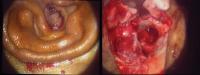 Fig. 7 Image showing aural polyp in brain herniation with the tegmen tympani defect.
Finally, a 65-years-old female patient presented with grade II House–Brackman facial
nerve palsy, otorrhea, and aural polyp. Radiological investigation revealed a mass
arising from the facial nerve. On mastoid exploration, mass was excised from the facial
nerve followed by grafting was done. The mass was sent for histopathology, revealed
as facial neuroma. Patient is on regular follow-up and facial nerve palsy has improved
([Fig. 8]).
 Fig. 8 Image showing aural polyp in Facial Neuroma.
Discussion
In our study, 81 patients were diagnosed with aural polyps from April 1997 to April
2022. The majority were male, with involvement of right ear being more frequent than
of the left. Among our cohort, 46% had associated cholesteatoma and 27% had simple
granulation polyp, followed by malignant otitis externa, brain herniation, glomus
tumors, foreign bodies, tuberculosis, keratosis obturans, and exostosis of the external
auditory canal. The main presenting complaints were feeling of blockage and foul-smelling
otorrhoea, followed by tinnitus and otalgia. Preoperatively, all patients underwent
a detailed ENT examination, as well as audiological and radiological evaluations.
The anatomy of the ear with anomalies and the different pathologies have been noted,
and all patients underwent mastoid exploration and reconstruction. The mass in the
external auditory canal was sent for histopathological evaluation, and the reports
were documented.
Aural polyp is considered a misnomer. Due to the high prevalence of chronic suppurative
otitis media, with the common clinical presentations like foul-smelling ear discharge,
and difficulty hearing, patients with sinister lesions can get inadvertently misdiagnosed,
leading to improper treatment. A preoperative biopsy cannot establish a correct diagnosis
since it shows only a peripheral part of the underlying disorder and can even lead
to complications, in the case of vascular lesions. Hence, a detailed, thorough ENT
and radiological evaluation is mandatory. A high resolution CT scan of the temporal
bone is the preferred radiological imaging to understand the complexities and to proceed
with the management.
According to the literature, polyps related to chronic suppurative otitis media and
due to underlying inflammatory pathology are common or secondary to pulmonary or other
systemic tuberculosis.[3] Studies have estimated the incidence of granulomatous diseases as 3 to 5% in the
surgical specimens.[4] Furthermore, there are documented cases of tuberculosis presentation with multiple
tympanic membrane perforations, as well as limited presentations of tuberculous otitis
media. The aberrant course of the internal carotid artery in the middle ear is also
known;[5] in our study, the artery presented as a vascular loop, and after mastoidectomy it
has been covered with temporalis fascia grafting. With dehiscence of the floor of
the middle ear wall, the high jugular bulb can be seen even up to the level of the
stapes supra structure.[6] However, there are no studies in literature is quoted on Tuberculosis presenting
as aural polyp.
Tegmen erosion can happen secondary to any extensive squamous disease, due to underlying
inflammatory or malignant pathology, trauma, and/or brain herniation[7]
[9]
[10]. In our study, the brain herniation presented as an aural polyp. In one case, blind
sac closure was done; in another, reconstruction of the defect and cranialization
of the mastoid cavity were done. In the modern era, radiological evaluations and innovations
to navigating surgeries play a pivotal role—especially among the surgeons.[8] A thorough visualization of the normal vital structures with their deviations and
disease progressions is vital prior to any extensive surgeries. In the majority of
our cases, radiological evaluation was documented as soft tissue attenuation with
hyperintense or hypointense areas involving the external auditory canal, middle ear,
and mastoid cavity.
Few publications have documented the importance of preoperative biopsy for a definitive
diagnosis, but we do not recommend it without a better understanding of the underlying
pathology. Polyps must be explored in a setting with available facilities to tackle
any complications. When intraoperatively accessing the polyps, especially from the
retro tympanum, utmost care is required. Mass lesions can never be pulled, so it is
important to avoid using sharp instruments near them while elevating the tympanomeatal
flap. Avoiding the fibrous annulus is also recommended in case of vascular lesions.
In cases of presentations of aural polyps, medical professionals must rely on a thorough
detailed clinical history, clinical examination including any surrounding structures
in case of extension, as well as underlying inflammatory processes. An in-depth radiological
evaluation is needed prior to surgery. Utmost care and meticulousness are advised
while working with aural polyps, and histopathological tissue diagnosis postoperatively
is mandatory so as not to compromise the patients' definitive treatment.
Conclusion
Aural polyps are a misnomer. They can manifest as symptoms within the ear per se or
in the surrounding structures. A thorough, detailed examination and mastoid exploration,
along with radiological and histopathological evaluation, are mandatory for the sake
of treatment. Utmost care and meticulousness are advised for surgeons when dealing
with aural polyps, to avoid any complications.


