RSS-Feed abonnieren
 PDF herunterladen
DOI: 10.1055/a-1517-9498
Endovenous treatment for recurrent varicose veins deriving from the saphenofemoral and saphenopopliteal junction: technique, limits, and review of the available literature
Artikel in mehreren Sprachen: deutsch | EnglishAutor*innen

Abstract
Introduction Endovascular techniques such as laser or radiofrequency are well established in the primary treatment of varicose veins and are supported by extensive literature and guideline recommendations. In contrast, there are only a small number of published studies on endovenous treatment for recurrences.
Methods In this paper, the existing literature is first analysed. Subsequently, own experiences and techniques for endovenous treatment of recurrence are presented and possible limitations of the method are discussed.
Results In the Pubmed search, 7 relevant papers on observational studies were found. One paper presented the results of a prospective randomised study comparing radiofrequency versus surgery. In most published studies, case selection was performed, with the presence of a longer truncal vein segment being a prerequisite for thermal ablation. The results regarding morbidity and closure rates are favourable, although long-term data are lacking. In our own practice, recurrences are regularly treated with endovenous therapy, mainly with the latest radial lasers. We also treat lesions that do not have a straight vein or only have a short segment of straight veins, for example, stumps or neovascularisations of the former saphenofemoral or saphenopopliteal junction. Technical tools that enable effective ablation of a recurrence in most cases are presented in this paper. Particular emphasis is placed on the direct puncture of a stump or shorter vein segments, as well as the threading in the context of the puncture of tortuous vein segments. Anatomical constellations in which endovenous thermal ablation may not be the method of first choice should be discussed. Examples of this are extremely tortuous, severely dilated vein segments, or very diffuse, small-calibre neovascularisations.
Conclusion In summary, endovenous thermal ablation for recurrent varicose veins appears to be an effective treatment modality that works even in anatomically challenging situations with short stumps and tortuous vein courses. However, a broader study activity on this would be desirable.
Introduction
Endovenous thermal ablation of insufficient vein segments in case of truncal venous insufficiency has become a standard procedure in the past 15 years. The wide adoption of this procedure, particularly compared with classical crossectomy and stripping, can be attributed to its generally low surgical burden with minimal invasiveness and potentially lower risk of post-operative haematomas and pain. Furthermore, owing to their effectiveness, laser and radiofrequency ablations have been incorporated in the guidelines of professional societies for primary varicose veins. For example, in the NICE guidelines from the UK and guidelines of the Society for Vascular Surgery and American Venous Forum in the US, endovenous thermal ablation was preferred to classical surgical procedures [1] [2]. Moreover, in the current guideline of the European Society for Vascular Surgery (ESVS) published in 2015, radiofrequency and laser ablations of the great saphenous vein (GSV) are a 1A recommendation to crossectomy in combination with stripping’ [3].
In Germany, the procedure is considered equivalent to surgery in the recent guideline issued by the German Society of Phlebology [4]. However, the use of endovenous thermal ablation in the treatment of recurrent varicose veins is less established. Recurrences occur after all types of varicose vein treatment. A recurrence rate of up to 65 % after 11 years has been reported in the literature [3]. After varicose vein surgery or endovenous ablation for insufficiency of the GSV or small saphenous vein (SSV), the recurrence of inguinal or popliteal varicose veins is common and requires careful management. From a surgical perspective, elimination of recurrence at the proximal insufficiency point, analogous to classical surgical procedures or endovenous intervention, is the most consistent type of treatment. However, because of subsequent treatment, the open surgical treatment of such a condition is technically challenging and is associated with a high risk of complications [5] [6].
The ESVS guideline recommends considering endovenous ablation of the recurrent varicosis if it appears to be suitable [3]. However, the boundaries at which this method appears suitable are dynamic . Conversely, considering progress in the development of catheter systems, such as radially emitting laser fibres with wavelengths of 1470 nm and 1940 nm, and with increasing experience of the clinicians, this study aimed to examine the current state of endovenous thermal ablation for recurrent varicose veins in the available literature and from the perspective of a regular user.
Morphology of recurrences
In this section, we present the morphological characteristics of recurrence based on our clinical experience. Presenting an analysis similar to existing or newer classifications for recurrences after surgical or endovenous pre-treatment would be too complex in this study; reference is made to specific literatures for this purpose [7] [8] [9]. The aetiology of recurrences, i.e. whether a stump or neovascularisation predominates, cannot always be clearly assigned sonographically [10].
On the one hand, distal recurrence findings are regularly found where there is no detectable connection to the former juction of the pre-treated vein area. In most cases, such recurrences can be treated well with endovenous therapy, especially if they include larger perforating veins or refluxive parts of residual truncal veins or large side branches.
In varicose vein recurrences originating from the former saphanofemoral or saphenopopliteal junction, the proximal insufficiency point is the (former) transition of the treated vein with the deep vein. Cases may show a defined stump or varicose bundles/tangles without a defined stump. In either case, thermal ablation is sometimes challenging. Periodically, this varicose vein new reflux is part of a more extensive recurrence network involving dependent, relatively straight reflux truncal vein segments, in which the latter is often easier to occlude thermally than the supplying proximal insufficiency point.
The endovenous treatment of varicose vein recurrences can also be relatively easy to perform, particularly if a persistent varicose vein stump is directly connected with a similarly persistent, straight truncal vein residue or large side branch, such as the anterior accessory saphenous vein (AASV). This pattern recurs after endovenous thermal ablation of the GSV when the AASV, which also opens in the varicose vein area, is not thermally sealed. An improvement may result from the flush occlusion of the GSV, in which inflowing side branches in the varicose vein area may be sealed more effectively, or through prophylactic ablation of the AASV [11] [12] [13].
In a special consecutive case series, the proportion of recurrent varicose veins originating from the safenofemoral junction, which may be designated as technically ‘difficult,’ since there were stumps or neovascularizations, was 63 %. In contrast, 37 % are attributable to a somewhat ‘easier’ group with a persistent, refluxing truncal vein [14].
Endovenous thermal ablation of recurrent varicose veins: Literature review
Initially, a Pubmed search was performed with the following search terms: recurrence, recurrent, recurring, relapse, varicose, varicosis, varices, laser and radiofrequency. Additionally, current relevant guidelines of the DGP, ESVS and AFV were analysed. In total, only eight relevant papers were identified ([Table 1]). However, we cannot preclude that there are more unrecorded study data on this topic. The main findings from the literature review are briefly summarised in the following chapter.
|
(first) author, year |
method |
study type |
n |
therapy success |
follow-up |
|
Hinchliffe, 2006 [15] |
radiofrequency |
randomised double-blind study |
16 (RFA) 16 (OP) |
16/16 16/16 |
only post-operative mortality was evaluated. RFA had a significantly better pain score and fewer haematomas. |
|
Nwaejike, 2010 [19] |
laser (bare fibre) |
consecutive case series |
77 |
100 % |
median follow-up duration, 18 months (range, 1–38) |
|
van Groenendael, 2009 [16] |
laser (bare fibre) |
prospective cohort study |
67 (ELLA) 149 (OP) |
81 % (ELLA) 71 % (OP) |
GSV recurrences, 6-month follow-up |
|
van Groenendael, 2010 [17] |
laser (bare fibre) |
prospective cohort study |
26 (ELLA) 16 (OP) |
26/26 EVLA) 15/16 (OP) |
SSV recurrences, initial technical success |
|
Theivacumar, 2011 [18] |
laser (bare fibre) |
prospective matched-pair study |
104 (recurrence) |
102/104 |
3 months |
|
Turtulici, 2017 [20] |
radiofrequency |
case series |
37 |
24/29 |
12 months |
|
Cavallini, 2018 [21] |
radial laser |
consecutive case series |
9 |
8/9 |
median follow-up duration, 8 months |
|
Müller, 2020 [14] |
radial laser |
consecutive case series |
35 |
34/35 |
only initial success was evaluated. |
Current status of the literature on thermal ablation for recurrent varicose veins with a truncal vein segment
A considerably detailed randomised, blinded study by Hinchliffe et al. analysed patients with recurrent varicose vein findings on both sides who were treated with radiofrequency in one limb and cross-revision and stripping in the other limb [15]. The patients were ‘blinded’ and did not know postoperatively which procedure had been performed on which side because the bandages were similar. Likewise, personnel who photographically documented haematomas were ‘blinded’ because the evaluation was performed after a few days of taking the photographs. As a result, the radiofrequency procedure was considered more favourable than surgery in terms of pain and haematoma development.
Two other studies on surgery, one on recurrent varicose veins in the GSV flow area [16] and the other on recurrent varicose veins of the SSV [17], had a prospective comparative study design and showed slightly better therapeutic success for endovenous treatment using bare fibre. Another prospective matched-pair analysis compared cases with endovenous laser ablation for recurrence with a contrast intervention with primary GSV or SSV insufficiency [18]. The longest follow-up duration published to date after laser ablation of a recurrence, based on a consecutive case series of 77 treatments, was reported by Nwaejike et al. [19]. During a median follow-up period of 18 months, a closure rate of 100 % was achieved.
Data on endovenous treatment of recurrences are mainly based on limited findings with persistent straight vein segments suitable for puncture and thermal ablation using bare fibre or radiofrequency catheters. In contrast, ablation of short varicose vein stumps or neovascularisation is not performed. From the abovementioned studies, a recommendation can be derived from the ESVS guideline that, correspondingly, endovenous thermal treatment for a suitable truncal vein should be considered [3].
Review of the literature on thermal ablation of varicose vein stumps
There is limited published data on endovenous thermal ablation of recurrence findings with short varicose vein stumps or those that correspond more to the phenotype of neovascularisation. In 2017, Turtulici et al. published a case series on radiofrequency ablation of recurrence findings with a rigid probe that was inserted not via a feeding vein but directly transcutaneously into the vein bundle to be sealed [20]. However, the device used was a probe applied in the thermal ablation of round foci in parenchymatous organs, such as liver tumours, and should not be combined with typical endovenous radiofrequency catheters such as Closurefast. During the follow-up period of 12 months, 24 of the 29 treated patients showed successful closures in the thermally treated area.
An Italian working group reported successful ablation of a complex recurrent varicose vein using a radial laser with a consecutive case series. The group used a wavelength of 1470 nm in the Elves Radial slim catheter. Varicose vein stumps were punctured with a peripheral vein catheter (16 G). Therefore, the tip of the plastic cannula was positioned close to the deep vein or advanced into it [21]. The use of several cannulas for the treatment of more extensive recurrences has also been described. In all (n = 9) treated cases of recurrence, additional varicosectomies were performed, and in 7 cases, sclerotherapies were conducted. During follow-up (average follow-up period, 8 months), successful treatment was noted in eight of nine cases.
In our published consecutive case series, the initial technical success of 35 treatments of varicose vein recurrence in the GSV flow area was analysed [14]. In 34 cases (97.1 %), successful early ablation was documented. Our study also made a distinction analogously to the ‘simple’ and ‘difficult’ types of varicose vein recurrence, in which effective endovenous treatment was evaluated as practicable in both situations.
Conclusion from the literature review
Two points can be derived as significant conclusions of the literature review: First, available data on the treatment of recurrent varicose veins, which are the basis of the ESVS guideline, describe only a subgroup, namely, that with straight vein segments to be treated with bare fibre or a radiofrequency catheter [3]. Second, no reliable statements can be made on the effectiveness of endovenous thermal ablation of problematic recurrent varicose veins, such as short varicose vein stumps or neovascularisation, based on Pubmed literature.
Techniques of endovenous treatment for varicose vein recurrence
Essentially, the technique performed at our institution corresponds to the procedure described by Cavallini et al. [21]. We used the latest-generation laser devices, such as the 1470-nm Elves Radial (Biolitec AG, Vienna) or 1940-nm Simla 6 (Ims GmbH, Tutzing). Because they deliver radial energy, modern lasers allow controlled sealing of the vein wall in projection to the sonographically trackable catheter tip.
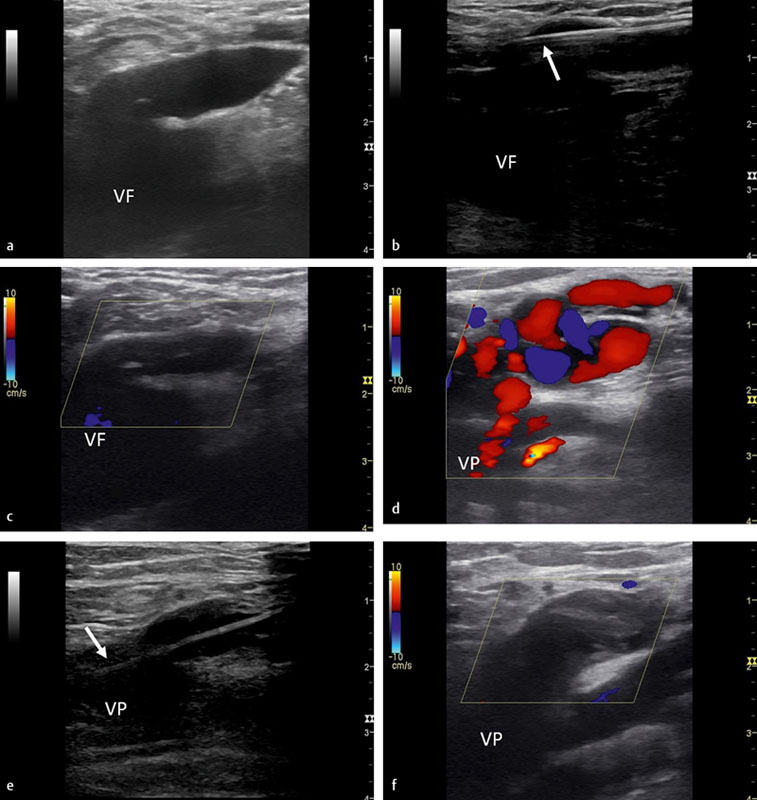
In cases where the transition between a varicose vein stump and the deep vein has a wide lumen (> 1 cm) and is sonographically well recognisable, the 1470-nm Elves Radial 2ring is preferentially used via the access created according to the Seldinger technique because of its high thermal effectiveness. First, the stump is punctured using a hypodermic needle and secured into the deep vein, utilizing a guidewire with feed. Then, a 6-Fr vein lock is advanced, followed by the catheter, into the deep vein. After pulling the lock, the catheter is withdrawn under ultrasound guidance until its tip reaches the transition between the stump and deep vein ([Fig. 1]). Subsequently, the tumescent solution is inserted, and care must be taken to ensure that this does not significantly change the position of the catheter tip. If this occurs, it needs to be corrected, which may be time-consuming after tumescent infusion due to poor ultrasound conditions.

The abovementioned steps, which may be challenging and require a specific routine in the endovenous technique, are facilitated by the use of general anaesthesia and, simultaneously, the use of little or no tumescence.
Occasionally, the transition from the recurrent varicose vein to the deep vein cannot be identifiable; thus, based on the Seldinger technique, access is not possible. One option is using thinner Elves Radial 2ring Slim-Fraser fibre (Biolitec) or analogously the Ims400-Fraser (Ims GmbH). They can be inserted through 16-G venous cannulas, whereby the latter is extremely easy to place with their tip in the position where laser ablation is to be initiated. Even if the area of effective transition into the deep vein is not permanently sealed, successful ablation is achieved in most cases. In case of more complex recurrences of varicose veins, this technique can be used to puncture several vein segments through the cannula prior to the procedure and, thus, secure them for further thermal treatment before the inserted tumescence prevents further punctures ([Fig. 2]).

Another technique is the threading of longer, curved vein sections onto the puncture cannula. Within limits, we also accept it here if the venous cannula runs in a short-stretch paravascular manner. For this purpose, the position of the transducer may vary to optimally follow the course of the vein. From our perspective, it is always advantageous to eliminate the varicose reservoir as effectively as possible. Thus, simultaneous with the treatment of a varicose vein recurrence, more distally located reflux vein sections should be treated using laser therapy or foam sclerotherapy or excision for tortuos varicose veins. Another helpful technique is the retrograde puncture of the superficial epigastric vein or superficial circumflex iliac vein if varicose drainage occurs from these veins.
Pitfalls and possible limitations of endovenous recurrence treatment
In a large number of cases, recurrent varicose veins can be safely treated by endovenous thermal treatment. The special situation of recurrence with often shorter and more curved vein segments to be treated results in the inherent challenges of the procedure. There are also challenges involved in the introduction of the guidewire. For example, neovascularisations often have a weak vein wall, which is often less prominent and much more demanding to cannulate with the patient lying down than with the patient standing during examination. Foam sclerotherapy is sometimes a more suitable method. Compared with that during primary treatment, the haptics during direct puncture and cannulation, according to the Seldinger technique, at the varicose vein stump is uncommon due to scar tissue. It is sometimes also challenging to visualise the correct catheter placement, particularly after the insertion of tumescence. For instance, when a laser catheter slips out during manipulation or insertion of tumescence, a new puncture and cannulation are required; in the worst-case scenario, this cannot be performed further in the same session due to the presence of tumescence.
With extremely diffuse or highly meandering, highly dilated recurrent varices and extremely diffuse, disseminated varicose veins, methodical limitations depend on the operator’s experience. In this study, other treatment methods, such as surgery or foam sclerotherapy, can be considered.
Conclusion and outlook
Based on the available literature and guidelines, endovenous treatment of varicose vein recurrence is possible and can be considered a valuable approach provided that it is supported by the technical and anatomical–morphological conditions. Due to advancements in catheter development, where the use of radial laser systems is emphasised, as well as due to advancements in technology and user experience, the application of this technique for varicose vein stump and neovascularisation is possible and is widespread.
However, the scientific monitoring of this exciting method appears to be limited. This is disappointing as it limits the value of future guideline recommendations, which should be based on evidence from studies. Thus, endovenous thermal ablation should be further investigated for its therapeutic properties in the prevention of complex varicose vein recurrences, preferably via high-quality prospective or comparative studies.
The translation of this article was made possible by the kind support of the following companies:
Bauerfeind AG
medi GmbH & Co. KG
Ofa Bamberg GmbH
Sigvaris GmbH
Interessenkonflikt
Die Autoren erklären die folgenden Interessenkonflikte: L. Müller hat eine Beratervereinbarung mit der Firma Biolitec, welche Honorare für Vorträge beinhaltet. Mitgliedschaften: L. Müller: Mitglied der Deutschen Gesellschaft für Phlebologie (DGP) und der Deutschen Gesellschaft für Chirurgie; J. Alm: Mitglied der DGP.
-
Literatur
- 1 O’Flynn N, Vaughan M, Kelley K. Diagnosis and management of varicose veins in the legs: NICE guideline. Br J Gen Pract 2014; 64: 314-315
- 2 Gloviczki P, Comerota AJ, Dalsing MC. et al. The care of patients with varicose veins and associated chronic venous diseases: Clinical practice guidelines of the Society for Vascular Surgery and the American Venous Forum. Journal of Vascular Surgery 2011; 53: 2S-48S
- 3 Wittens C, Davies AH, Bækgaard N. et al. Editor’s Choice – Management of Chronic Venous Disease: Clinical Practice Guidelines of the European Society for Vascular Surgery (ESVS). Eur J Vasc Endovasc Surg 2015; 49: 678-737
- 4
Pannier F,
Noppeney T,
Alm J.
et al. S2k-Leitlinie Diagnostik und Therapie der Varikose. https://www.awmf.org/uploads/tx_szleitlinien/037-018l_S2k_Varikose_Diagnostik-Therapie_2019-07.pdf
- 5 Pittaluga P, Chastanet S, Locret T. et al. Retrospective evaluation of the need of a redo surgery at the groin for the surgical treatment of varicose vein. J Vasc Surg 2010; 51: 1442-1450
- 6 Hayden A, Holdsworth J. Complications following re-exploration of the groin for recurrent varicose veins. Ann R Coll Surg Engl 2001; 83: 272-273
- 7 Perrin MR, Labropoulos N, Leon LR. Presentation of the patient with recurrent varices after surgery (REVAS). J Vasc Surg 2006; 43: 327-334 ; discussion 334
- 8 Stonebridge PA, Chalmers N, Beggs I. et al. Recurrent varicose veins: a varicographic analysis leading to a new practical classification. Br J Surg 1995; 82: 60-62
- 9 Zollmann M, Zollmann C, Zollmann P. et al. Recurrence types 3 years after endovenous thermal ablation in insufficient saphenofemoral junctions. J Vasc Surg Venous Lymphat Disord 2021; 9: 137-145
- 10 Geier B, Mumme A, Hummel T. et al. Validity of duplex-ultrasound in identifying the cause of groin recurrence after varicose vein surgery. J Vasc Surg 2009; 49: 968-972
- 11 Spinedi L, Stricker H, Keo HH. et al. Feasibility and safety of flush endovenous laser ablation of the great saphenous vein up to the saphenofemoral junction. J Vasc Surg Venous Lymphat Disord 2020; 8: 1006-1013
- 12 Müller L, Alm J. Feasibility and potential significance of prophylactic ablation of the major ascending tributaries in endovenous laser ablation (EVLA) of the great saphenous vein: A case series. PLoS One 2021; 16: e0245275
- 13 Hartmann K. Endovenous (minimally invasive) procedures for treatment of varicose veins: The gentle and effective alternative to high ligation and stripping operations. Hautarzt 2020; 71: 67-73
- 14 Müller L, Alm J. Feasibility and technique of endovenous laser ablation (EVLA) of recurrent varicose veins deriving from the sapheno-femoral junction-A case series of 35 consecutive procedures. PLoS One 2020; 15: e0235656
- 15 Hinchliffe RJ, Ubhi J, Beech A. et al. A prospective randomised controlled trial of VNUS closure versus surgery for the treatment of recurrent long saphenous varicose veins. Eur J Vasc Endovasc Surg 2006; 31: 212-218
- 16 van Groenendael L, van der Vliet JA, Flinkenflögel L. et al. Treatment of recurrent varicose veins of the great saphenous vein by conventional surgery and endovenous laser ablation. J Vasc Surg 2009; 50: 1106-1113
- 17 van Groenendael L, Flinkenflögel L, van der Vliet JA. et al. Conventional surgery and endovenous laser ablation of recurrent varicose veins of the small saphenous vein: a retrospective clinical comparison and assessment of patient satisfaction. Phlebology 2010; 25: 151-157
- 18 Theivacumar NS, Gough MJ. Endovenous laser ablation (EVLA) to treat recurrent varicose veins. Eur J Vasc Endovasc Surg 2011; 41: 691-696
- 19 Nwaejike N, Srodon PD, Kyriakides C. Endovenous laser ablation for the treatment of recurrent varicose vein disease – A single centre experience. International Journal of Surgery 2010; 8: 299-301
- 20 Turtulici G, Furino E, Dedone G. et al. Percutaneous treatment with radiofrequency ablation of varicose veins recurring after vein stripping surgery A preliminary study. Ann Ital Chir 2017; 6: 438-442
- 21 Cavallini A, Marcer D, Ferrari Ruffino S. Endovenous laser treatment of groin and popliteal varicose veins recurrence. Phlebology 2018; 33: 195-205
Korrespondenzadresse
Publikationsverlauf
Artikel online veröffentlicht:
28. Juli 2021
© 2021. Thieme. All rights reserved.
Georg Thieme Verlag KG
Rüdigerstraße 14, 70469 Stuttgart, Germany
-
Literatur
- 1 O’Flynn N, Vaughan M, Kelley K. Diagnosis and management of varicose veins in the legs: NICE guideline. Br J Gen Pract 2014; 64: 314-315
- 2 Gloviczki P, Comerota AJ, Dalsing MC. et al. The care of patients with varicose veins and associated chronic venous diseases: Clinical practice guidelines of the Society for Vascular Surgery and the American Venous Forum. Journal of Vascular Surgery 2011; 53: 2S-48S
- 3 Wittens C, Davies AH, Bækgaard N. et al. Editor’s Choice – Management of Chronic Venous Disease: Clinical Practice Guidelines of the European Society for Vascular Surgery (ESVS). Eur J Vasc Endovasc Surg 2015; 49: 678-737
- 4
Pannier F,
Noppeney T,
Alm J.
et al. S2k-Leitlinie Diagnostik und Therapie der Varikose. https://www.awmf.org/uploads/tx_szleitlinien/037-018l_S2k_Varikose_Diagnostik-Therapie_2019-07.pdf
- 5 Pittaluga P, Chastanet S, Locret T. et al. Retrospective evaluation of the need of a redo surgery at the groin for the surgical treatment of varicose vein. J Vasc Surg 2010; 51: 1442-1450
- 6 Hayden A, Holdsworth J. Complications following re-exploration of the groin for recurrent varicose veins. Ann R Coll Surg Engl 2001; 83: 272-273
- 7 Perrin MR, Labropoulos N, Leon LR. Presentation of the patient with recurrent varices after surgery (REVAS). J Vasc Surg 2006; 43: 327-334 ; discussion 334
- 8 Stonebridge PA, Chalmers N, Beggs I. et al. Recurrent varicose veins: a varicographic analysis leading to a new practical classification. Br J Surg 1995; 82: 60-62
- 9 Zollmann M, Zollmann C, Zollmann P. et al. Recurrence types 3 years after endovenous thermal ablation in insufficient saphenofemoral junctions. J Vasc Surg Venous Lymphat Disord 2021; 9: 137-145
- 10 Geier B, Mumme A, Hummel T. et al. Validity of duplex-ultrasound in identifying the cause of groin recurrence after varicose vein surgery. J Vasc Surg 2009; 49: 968-972
- 11 Spinedi L, Stricker H, Keo HH. et al. Feasibility and safety of flush endovenous laser ablation of the great saphenous vein up to the saphenofemoral junction. J Vasc Surg Venous Lymphat Disord 2020; 8: 1006-1013
- 12 Müller L, Alm J. Feasibility and potential significance of prophylactic ablation of the major ascending tributaries in endovenous laser ablation (EVLA) of the great saphenous vein: A case series. PLoS One 2021; 16: e0245275
- 13 Hartmann K. Endovenous (minimally invasive) procedures for treatment of varicose veins: The gentle and effective alternative to high ligation and stripping operations. Hautarzt 2020; 71: 67-73
- 14 Müller L, Alm J. Feasibility and technique of endovenous laser ablation (EVLA) of recurrent varicose veins deriving from the sapheno-femoral junction-A case series of 35 consecutive procedures. PLoS One 2020; 15: e0235656
- 15 Hinchliffe RJ, Ubhi J, Beech A. et al. A prospective randomised controlled trial of VNUS closure versus surgery for the treatment of recurrent long saphenous varicose veins. Eur J Vasc Endovasc Surg 2006; 31: 212-218
- 16 van Groenendael L, van der Vliet JA, Flinkenflögel L. et al. Treatment of recurrent varicose veins of the great saphenous vein by conventional surgery and endovenous laser ablation. J Vasc Surg 2009; 50: 1106-1113
- 17 van Groenendael L, Flinkenflögel L, van der Vliet JA. et al. Conventional surgery and endovenous laser ablation of recurrent varicose veins of the small saphenous vein: a retrospective clinical comparison and assessment of patient satisfaction. Phlebology 2010; 25: 151-157
- 18 Theivacumar NS, Gough MJ. Endovenous laser ablation (EVLA) to treat recurrent varicose veins. Eur J Vasc Endovasc Surg 2011; 41: 691-696
- 19 Nwaejike N, Srodon PD, Kyriakides C. Endovenous laser ablation for the treatment of recurrent varicose vein disease – A single centre experience. International Journal of Surgery 2010; 8: 299-301
- 20 Turtulici G, Furino E, Dedone G. et al. Percutaneous treatment with radiofrequency ablation of varicose veins recurring after vein stripping surgery A preliminary study. Ann Ital Chir 2017; 6: 438-442
- 21 Cavallini A, Marcer D, Ferrari Ruffino S. Endovenous laser treatment of groin and popliteal varicose veins recurrence. Phlebology 2018; 33: 195-205