


Subscribe to RSS
 Download PDF

DOI: 10.1055/s-0046-1816535
Effect of 32% Hydrogen Peroxide Bleaching on Surface Properties and Staining Susceptibility of CAD/CAM Hybrid and Feldspathic Ceramics Under Simultaneous Thermocycling–Staining Challenge
Authors
Funding The authors acknowledge the support provided by Ajman University for covering the publication fee.

Abstract
Objectives
Resistance to post-bleaching staining and preservation of surface properties are critical to long-term durability of restorations. This study evaluated the effect of 32% hydrogen peroxide (H2O2) in-office bleaching gel on surface roughness (Ra), microhardness, and staining susceptibility of three hybrid computer-aided design/computer-aided manufacturing (CAD/CAM) materials compared with a feldspathic ceramic, subjected to a combined thermocycling–staining protocol.
Materials and Methods
Slice specimens (n = 14/material) were prepared from hybrid ceramic materials: Vita Enamic (VE); Lava Ultimate (LU); Shofu Block HC (SB); and from a feldspathic ceramic material, VitaBlocs Mark II (VB), which served as the control. Seven slices per material underwent CIEDE2000 color difference analysis (ΔE00) after simultaneous staining and thermocycling (1,000 cycles, 5–55°C), with or without a prior bleaching procedure using 32% H2O2 gel for three 15-minute cycles. The remaining slices were evaluated for surface roughness (Ra) and Vickers microhardness (VH) before and after bleaching with 32% H2O2.
Statistical Analysis
Data were analyzed using two-way ANOVA and the Tukey test (α = 0.05).
Results
The results showed that bleaching produced no significant changes in ΔE00, Ra, or Vickers hardness number (VHN) for VE, LU, or SB (P > 0.05). VB alone showed a significant reduction in hardness (454 → 323 HV; p < 0.001). Post-staining ΔE00 values remained below the 1.8 clinical acceptability threshold for LU and SB but slightly exceeded it for the non-bleached VE group (≤2.2) and were high for VB (>8). Regardless of bleaching, VB exhibited the greatest color change, whereas SB had the lowest hardness. Ra values for SB and VB were above the critical threshold for bacterial adhesion (0.02 µm).
Conclusions
Although a single session of 32% H2O2 in-office bleaching significantly decreases the hardness of unglazed feldspathic ceramic, it does not compromise the surface integrity or color stability of hybrid CAD/CAM materials. Therefore, the tested hybrid materials can be safely subjected to 32% H2O2-based in-office bleaching without requiring surface pretreatment or postoperative replacement due to material degradation. However, restorative materials should be selected based on a comprehensive assessment of esthetic and mechanical performance to ensure long-term clinical success.
Keywords
CAD/CAM - hybrid ceramic - microhardness - color stability - staining susceptibility - surface roughness - in-office bleaching - hydrogen peroxideIntroduction
Over the past two decades, the growing demand for esthetic dentistry has made eliminating both extrinsic and intrinsic tooth discoloration a routine clinical request as patients increasingly desire a brighter, whiter smile.[1] Among the conservative options available—micro-abrasion, macro-abrasion, veneering, and bleaching—chairside bleaching is widely regarded as the least invasive means of achieving predictable color improvement in sound enamel.[2] Contemporary bleaching agents employ hydrogen peroxide (H2O2) or its precursor, carbamide peroxide, which liberates H2O2 on decomposition.[3] These formulations may be activated chemically or by photo-activation to accelerate free-radical release.[4]
Hybrid computer-aided design/computer-aided manufacturing (CAD/CAM) ceramics were introduced to couple the dentin-like elasticity of resin composites with the favorable optical, mechanical, and biological attributes of feldspathic porcelain. This elastic–ceramic synergy allows the material to absorb functional stress without permanent deformation or catastrophic fracture.[5] Clinical observations further indicate that hybrids are wear-resistant, kinder to opposing dentition, and require shorter milling times than conventional ceramics.[6] [7] Despite excellent chipping resistance and straightforward intra-oral maintenance, their relatively low flexural strength (150–240 MPa) currently limits indications to single-unit restorations—veneers, inlays, onlays, and crowns (especially implant-supported crowns where no periodontal ligament shock absorption exists).[7]
Bleaching agents may inadvertently get in contact with the pre-existing restorations during the routine in-office bleaching session.[8] Moreover, the literature shows that bleaching agents demonstrate effective outcomes in the color recovery of stained restorations.[9] [10] Multiple investigations have explored how peroxide-based bleaching influences restorative materials, yet outcomes remain inconsistent. Some authors report increased surface roughness and up to a 15% reduction in hardness for feldspathic porcelain after exposure to 10 to 16% carbamide peroxide.[11] Significant color shifts have likewise been documented in feldspathic ceramics following 10% H2O2 or carbamide peroxide bleaching.[12] Conversely, other studies found negligible changes in certain esthetic materials under similar condition.[13] [14] Mechanistically, free radical penetration and subsequent alkali ion leaching may induce glass-phase dissolution within ceramics, elevating surface roughness beyond the 0.2 µm plaque-retention threshold and thereby predisposing to secondary caries, periodontal inflammation, and compromised esthetics.[15] [16] Variations across earlier studies likely stem from differences in material composition, baseline properties, bleaching agent concentration, and application protocols. Notably, limited evidence exists regarding peroxide effects on the latest generation of hybrid ceramics, whose unique polymer–ceramic networks may respond differently to oxidative challenges.[17] Clarifying these interactions is essential to guide pre-bleaching precautions and post-bleaching maintenance. Furthermore, prior research has primarily focused on the impact of low-concentration at-home bleaching products on the surface and optical properties of various restorative materials, with less attention paid to the influence of high-concentration in-office bleaching products and the susceptibility of restorative materials to staining after bleaching. In the limited studies that have evaluated post-bleaching staining resistance, either hot or cold coffee or red wine has typically been used, and investigations have been primarily confined to bleaching protocols involving 10 to 16% carbamide peroxide or 40% non-light-activated H2O2.[18] [19] [20] [21] [22] [23] The potential influence of other commonly consumed staining agents, such as tea and citrus juices, as well as the role of thermocycling, has not been adequately explored. Repeated thermal fluctuations are known to induce microcrack formation and interfacial gaps opening within restorative materials, thereby facilitating deeper penetration of staining solutions and accelerating discoloration.[24] [25] [26]
To the best of our knowledge, the effect of light-activated 32% H2O2 in-office bleaching on the staining susceptibility of CAD/CAM restorative materials has not yet been investigated. Furthermore, no previous study has assessed this effect under simultaneous thermocycling and staining conditions using both hot and cold beverages, which more closely replicate the thermal and chemical challenges encountered in the oral environment. Consequently, the present study addresses this important gap by introducing a clinically relevant experimental model to evaluate the combined effects of bleaching, temperature variation, and staining on CAD/CAM hybrid and feldspathic ceramics.
Accordingly, this in vitro study investigated the influence of an in-office 32% H2O2 regimen on surface roughness, microhardness, and stain susceptibility of three commercially distinct hybrid ceramics—Vita Enamic (VE) (VITA Zahnfabrik), Lava Ultimate (LU) (3M ESPE), and Shofu Block HC (SB) (Shofu)—compared with VitaBlocs Mark II feldspathic ceramic (VB) (VITA Zahnfabrik) subjected to a combined thermocycling–staining protocol. The null hypotheses tested in this study were as follows:
-
(1) In-office bleaching with 32% H2O2 does not significantly increase the susceptibility of hybrid ceramics to staining;
-
(2) In-office bleaching does not cause detrimental changes in the surface roughness or microhardness of hybrid ceramics; and
-
(3) The effects of in-office bleaching on surface and optical properties do not differ significantly between hybrid ceramics and feldspathic ceramic materials.
Materials and Methods
Materials
Three hybrid CAD/CAM blocks were examined—one polymer-infiltrated ceramic (VE; VITA Zahnfabrik, Bad Säckingen, Germany), and two resin nano-ceramics (LU; 3M ESPE, St. Paul, MN, USA and SB; Shofu Inc., Kyoto, Japan). A feldspathic ceramic (VB; VITA Zahnfabrik, Bad Säckingen, Germany) served as the control. Nominal compositions are summarized in [Table 1].
|
Material |
Type |
Content[a] |
Manufacturer |
|---|---|---|---|
|
Vita Enamic |
Polymer infiltrated ceramic |
SiO2, Al2O3, Na2O, K2O, B2O3, ZrO2, CaO, UDMA, TEGDMA |
VITA Zahnfabrik |
|
Lava Ultimate |
Resin nano ceramic (RNC) |
Resin: Bis-GMA, UDMA, Bis-EMA, TEGDMA Fillers: SiO2, ZrO2, Si/ZrO2 cluster |
3M ESPE |
|
Shofu Block HC |
Zirconium silicate nanoparticles reinforced pre- polymerized resin matrix |
Filler composition: 61%, incl. zirconium silicate, silicon dioxide, micro-fumed silica Resin matrix: UDMA, TEGDMA |
Shofu |
|
VitaBlocs Mark II |
Leucite-reinforced glass ceramic |
Mixture of feldspathic crystalline particles embedded in a glassy matrix |
VITA Zahnfabrik |
Abbreviations: Bis-EMA, ethoxylated bisphenol A glycol dimethacrylate; BisGMA, bisphenol A glycol dimethacrylate; TEGDMA, triethylene glycol dimethacrylate; UDMA, urethane dimethacrylate.
a Manufacturer's data.
Sample Size Calculation
Sample size was estimated using G*Power (version 3.1), based on the means and standard deviations reported by Ghaemi et al,[27] which yielded a large effect size (Cohen's f = 0.4). A priori power analysis indicated that a minimum of six specimens per group would be required to detect significant differences at a significance level of α = 0.05 and power of 80%. To align with the methodology of previous studies evaluating the effect of bleaching on color stability of restorative materials, seven specimens per group were included in the present study.
Specimen Preparation
Each block was embedded in acrylic resin and sectioned with a low-speed precision saw (IsoMet 1000, Buehler, Lake Bluff, IL, USA) to obtain 14 slabs per material (thickness = 2 mm). Surfaces were standardized under water-cooling with 240-grit silicon-carbide papers (CarbiMet, Buehler Ltd., USA) for 60 seconds on a rotary polisher (MetaServ 250 Grinder-Polisher, Buehler Ltd., USA). Final gloss was achieved with a two-step ceramic polishing kit (Komet 4313B.204, Lemgo, Germany) to simulate the clinical surface condition post-cementation and occlusal adjustment.
In-office Bleaching Protocol
A 32% H2O2 gel (Fläsh, WHITEsmile, Birkenau, Germany) was applied to the polished top surfaces, after baseline measurements, for three consecutive 15-minute cycles and photo-activated with the manufacturer's lamp (Flash Whitening Lamp XG, Birkenau, Germany), operating at a wavelength of 460 nm and an irradiance of 190 mW/cm2. To ensure consistency, photo-activation was conducted at a standardized distance by positioning the lamp's light guide head directly on the benchtop surface, maintaining uniform proximity to all specimens. After each bleaching cycle, the gel was carefully aspirated, and the specimens were thoroughly rinsed with sterile saline prior to the application of fresh gel. All bleaching procedures were performed under controlled environmental conditions, with the room temperature maintained at 24°C.
Surface Roughness (Ra) and Microhardness (VHN)
Seven slabs from each group were randomly selected. Baseline roughness (Ra0) was measured with a contact profilometer (Surftest 211, Mitutoyo, Tokyo, Japan; 2 µm diamond stylus; cut-off 0.25 mm; evaluation length 1.25 mm). Vickers microhardness (VHN0) was determined with a micro-hardness tester (FM-800, Future-Tech, Kanagawa, Japan; 500 g load, 15 seconds dwell). Three readings per specimen were averaged. Vickers hardness (VHN) was calculated automatically (VHN = 1.854 F/D²). Three readings per specimen were averaged. After re-polishing, bleaching was performed according to the protocol described earlier, then measurements were repeated (Ra_W, VHN_W). Each surface property was evaluated by one trained operator, who performed all corresponding measurements.
Color Stability
The remaining seven slabs per material were used for color analysis. Color measurements were recorded at baseline for both the top and bottom surfaces, after staining for the top bleached surface (BS) and the bottom surface (S). A spectrophotometer (VITA EasyShade V, Vita Zahnfabrik, Bad Säckingen, Germany) was used over a white background. After calibration, the tip was placed perpendicular to each surface, and three readings were averaged per sample. Color analysis was performed by a single trained operator.
Staining and Aging
Specimens underwent 1,000 thermocycles (5 °C tea–orange juice mixture ↔55 °C coffee; dwell time: 30 s, transfer time: 15 s), following Ren et al.[28] Solutions were placed in stainless-steel baths of a programmable thermocycler (SD Mechatronik, Westerham, Germany). Post-cycling, Specimens were brushed lightly with commercial toothpaste (Close-Up White Now; 10 seconds), rinsed (de-ionized water, 30 seconds), and air-dried. Color was re-measured on the bleached (bleached-stained, BS) and unbleached (stained, S) surfaces of each specimen.
Color change was quantified using the CIEDE2000 (ΔE00) color-difference formula, in accordance with the standard developed by the Commission Internationale de l'Éclairage (CIE).[29] The ΔE00 value was calculated using the following equation:

Where ΔL', ΔC', and ΔH' represent differences in lightness, chroma, and hue, respectively. RT accounts for interactions between chroma and hue in the blue region. SL, SC, and SH are weighting functions. KL, KC, and KH are correction factors. A ΔE00 value of 1.8 was considered the clinical acceptability threshold.[30]
Statistical Analysis
Data (Ra, VHN, ΔE00) were analyzed with two-way ANOVA (factors = material, bleaching) followed by Tukey post-hoc tests (α = 0.05) using IBM SPSS Statistics v29.0.1 (IBM Corp., Armonk, NY, USA). Results are reported as mean ± standard deviation. Pearson correlation analysis was performed to explore potential associations between surface roughness, microhardness, and color change (ΔE00BS) following bleaching and staining procedures.
Results
The two-way ANOVA revealed that the staining susceptibility (ΔE00) of the tested materials was not significantly influenced by 32% H2O2 in-office bleaching (p = 0.883); therefore, the first null hypothesis was accepted. Similarly, in-office bleaching had no significant effect on surface roughness (Ra) (p = 0.603). In contrast, Vickers hardness number (VHN) was significantly affected by bleaching (p < 0.001), leading to rejection of the second null hypothesis.
The interaction between in-office bleaching and material type showed no significant effect on Ra or ΔE00 (p = 0.981 and p = 0.963, respectively). However, material type significantly influenced ΔE00, Ra, and VHN (p < 0.001). Moreover, VHN was significantly affected by the interaction between material type and bleaching (p < 0.001), supporting rejection of the third null hypothesis.
Post hoc comparisons revealed that 32% H2O2 had no statistically significant effect on the VHN of the tested CAD/CAM hybrid materials (VE, LU, and SB) (P > 0.05), as shown in [Table 2] and [Fig. 1]. In contrast, VB exhibited a significant reduction in VHN following bleaching (p < 0.001), although it retained the highest hardness values among all materials. SB consistently demonstrated the lowest VHN values, with significantly lower post-bleaching hardness compared with LUB, VEB, and VBB (p < 0.05).
Note: Within each column, values with the same superscript lowercase letter are not statistically significantly different (P > 0.05).
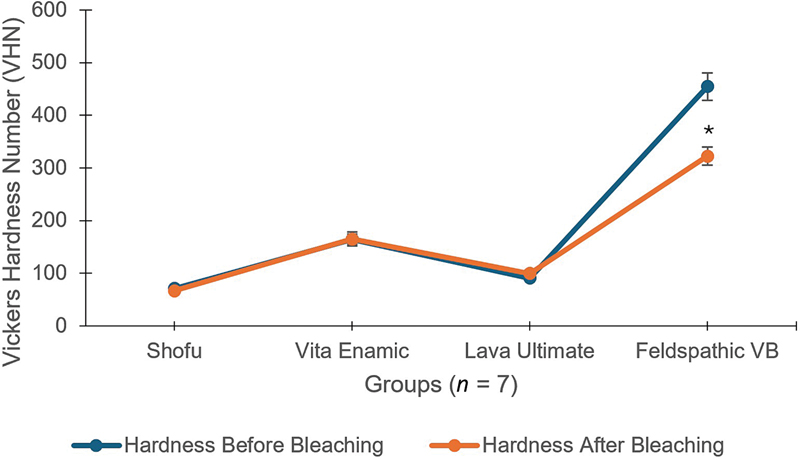
Moreover, as displayed in [Table 2] and [Figs. 2] and [3], post hoc comparisons showed that 32% H2O2 in-office bleaching had no statistically significant effect on ΔE00 or Ra for VE, LU, SB, or VB (p = 1.000). After staining, VB exhibited the highest ΔE₀₀ values in the unbleached (ΔE₀₀S) and bleached–stained (ΔE₀₀BS) groups, exceeding the clinical acceptability threshold and being significantly higher than those of VE, LU, and SB (p < 0.05). No significant differences in ΔE00 were observed among VE, LU, and SB (P > 0.05). Bleached hybrid material groups generally demonstrated lower ΔE₀₀ values than their unbleached counterparts, following aging and staining; however, these differences were not statistically significant. Statistical analysis also revealed that VE and LU exhibited significantly lower Ra values than SB and VB (p < 0.05), while no significant difference in Ra was observed between SB and VB.


Correlation analysis revealed a strong, statistically significant positive relationship between microhardness and the extent of stain susceptibility following bleaching and staining (ΔE00BS) (r = 0.967, p = 0.033). Conversely, the correlation between surface roughness and color change was weak and not statistically significant (r = 0.365, p = 0.635).
Discussion
Polymer-infiltrated ceramic network (PICN) and resin-nanoceramic blocks were conceived to unite the optical fidelity of porcelains with the stress-absorbing resilience of resin, thereby meeting the growing demand for restorations that preserve esthetics and surface integrity over time. Our results confirm that this design goal is largely achieved: a single 32% H2O2 bleaching session did not alter surface roughness (Ra) or color change (ΔE00) in VE, LU, or SB, whereas the feldspathic control, VB, showed the greatest color change after staining and high surface roughness regardless of the bleaching treatment. The absence of a bleaching effect on Ra and ΔE00 is consistent with earlier work on feldspathic porcelain and composites, suggesting that the highly cross-linked, pre-polymerized matrices of CAD/CAM hybrids confer resistance to peroxide challenge.[12] [31] [32]
Although profilometry is inherently two-dimensional,[33] the stable Ra values recorded here still carry clinical weight. Both VE and LU remained far below the 0.2 µm plaque-retention threshold, while SB and unglazed VB hovered just above it—differences attributable to filler size, porosity, and the loss of glaze during finishing.[34] [35] Importantly, bleaching neither exacerbated these rougher profiles nor generated new surface defects, thereby maintaining the wear compatibility of the restorations.
VE and SB showed no significant change in VHN after bleaching, and LU exhibited a modest increase, echoing the peroxide-related hardening reported by Rodrigues et al.[11] By contrast, VB lost nearly 30% of its Vickers hardness, an outcome attributed to peroxide-mediated silicate oxide (SiO2) leaching from the glass matrix.[36] [37] [38] Despite this reduction, VitaBlocs remained the hardest group, implying that fracture resistance may still be adequate if occlusal thickness is sufficient. Therefore, the hardness behavior was material-dependent.
LU and SB remained below the 1.8 ΔE00 acceptability limit after thermocycling and staining; VE sat marginally above it, whereas VB exceeded it markedly, mirroring the stain susceptibility of feldspathic ceramics reported by Ghinea et al.[39] The observation that bleaching slightly reduced ΔE00 in all hybrid groups supports the stain-lightening effect of peroxide on resin-containing ceramics.[40] [41]
These patterns align with the known chemistry of peroxide interaction. Roughening and hardness loss in composites are linked to polymer-matrix erosion,[17] [42] driven by highly diffusive free radicals.[43] [44] The prefabricated blocks tested here incorporate a densely cross-linked methacrylate network that resists oxidative cleavage,[45] explaining the minimal changes observed. Feldspathic porcelains, on the other hand, lack a protective polymer phase and present larger, more open silicate domains vulnerable to ion loss and pigment adsorption.[46]
In the present study, feldspathic ceramics were included as a control material and were polished using the same standardized protocol applied to the hybrid ceramics to ensure surface comparability. This approach is supported by previous studies demonstrating that polished feldspathic ceramics may exhibit surface roughness values comparable to, or even lower than, those of glazed surfaces.[47] [48] In addition, according to the manufacturer, VitaBlocs Mark II is designed for time-efficient fabrication and polishing without the need for an additional glazing firing step.[49] Furthermore, several studies investigating staining susceptibility and surface properties of CAD/CAM ceramics have employed polished VitaBlocs Mark II specimens without glazing.[50] [51]
The strong positive correlation between microhardness after bleaching and the extent of stain susceptibility following bleaching suggests that harder materials may exhibit more perceptible color shifts under the tested bleaching and staining conditions. Conversely, the weak correlation between surface roughness and stain susceptibility indicates that roughness changes may not strongly influence color alterations in the tested materials. These findings underscore the potential relevance of material hardness in predicting esthetic stability post bleaching.
Clinical Relevance
Within the study parameters, chairside 32% H2O2 bleaching can be safely offered to patients restored with the tested hybrid ceramics, as no additional polishing or glaze application appears necessary. In contrast, feldspathic restorations may benefit from pre-bleaching surface glazing and/or post-bleaching reglazing to offset potential reduction in hardness and color alteration.
Findings are confined to one bleaching concentration, a single thermocycling regimen, and a fixed staining protocol. The lack of formal reliability testing (e.g., intra-observer reliability analysis) is acknowledged as a limitation of the present study. Although literature-derived, profilometer-based roughness omits three-dimensional topography. Moreover, the ΔE₀₀ acceptability threshold may not mirror every clinical scenario.[30] [52] Coupling profilometry with SEM, testing multiple peroxide concentrations and application times, and conducting in vivo or in situ trials will clarify long-term clinical performance. Investigations into the chemical interactions that increased LU's hardness could also guide the formulation of peroxide gels tailored for restorative safety.
Conclusion
Within the limitations of this in vitro study, the application of a 32% H2O2-based in-office bleaching agent did not deteriorate the surface roughness, microhardness, or color stability of the tested CAD/CAM hybrid materials. Unglazed VitaBlocs Mark II exhibited a significant reduction in microhardness following bleaching; however, it retained the highest VHN among the tested materials. Despite its superior hardness, the extent of color change in VB after aging and staining was beyond the threshold of clinical acceptability.
Conflict of Interest
None declared.
-
References
- 1 El-Murr J, Ruel D, St-Georges AJ. Effects of external bleaching on restorative materials: a review. J Can Dent Assoc 2011; 77 (b59): b59
- 2 Polydorou O, Mönting JS, Hellwig E, Auschill TM. Effect of in-office tooth bleaching on the microhardness of six dental esthetic restorative materials. Dent Mater 2007; 23 (02) 153-158
- 3 Atali PY, Topbaşi FB. The effect of different bleaching methods on the surface roughness and hardness of resin composites. J Dent Oral Hyg 2011; 3 (02) 10-17
- 4 Hafez R, Ahmed D, Yousry M, El-Badrawy W, El-Mowafy O. Effect of in-office bleaching on color and surface roughness of composite restoratives. Eur J Dent 2010; 4 (02) 118-127
- 5 Della Bona A, Corazza PH, Zhang Y. Characterization of a polymer-infiltrated ceramic-network material. Dent Mater 2014; 30 (05) 564-569
- 6 Dirxen C, Blunck U, Preissner S. Clinical performance of a new biomimetic double network material. Open Dent J 2013; 7: 118-122
- 7 Bajraktarova-Valjakova E, Korunoska-Stevkovska V, Kapusevska B, Gigovski N, Bajraktarova-Misevska C, Grozdanov A. Contemporary dental ceramic materials, a review: chemical composition, physical and mechanical properties, indications for use. Open Access Maced J Med Sci 2018; 6 (09) 1742-1755
- 8 Attin T, Hannig C, Wiegand A, Attin R. Effect of bleaching on restorative materials and restorations—a systematic review. Dent Mater 2004; 20 (09) 852-861
- 9 Al-Angari SS, Eckert GJ, Sabrah AHA. Color stability, roughness, and microhardness of enamel and composites submitted to staining/bleaching cycles. Saudi Dent J 2021; 33 (04) 215-221
- 10 AlHabdan A, Alsuhaibani A, Alomran L, Almutib L. Effect of staining and external bleaching on the color stability and surface roughness of universal-shade resin-based composite. Clin Cosmet Investig Dent 2025; 17: 1-12
- 11 Rodrigues CRT, Turssi CP, Amaral FLB, Basting RT, França FMG. Changes to glazed dental ceramic shade, roughness, and microhardness after bleaching and simulated brushing. J Prosthodont 2019; 28 (01) e59-e67
- 12 Kara HB, Aykent F, Ozturk B. The effect of bleaching agents on the color stability of ceromer and porcelain restorative materials in vitro. Oper Dent 2013; 38 (01) E1-E8
- 13 Dishman MV, Baughan LW. Vital tooth bleaching—home use review and evaluation. Va Dent J 1992; 69 (02) 12-21
- 14 Polydorou O, Hellwig E, Auschill TM. The effect of at-home bleaching on the microhardness of six esthetic restorative materials. J Am Dent Assoc 2007; 138 (07) 978-984 , quiz 1022
- 15 Ourique SA, Arrais CA, Cassoni A, Ota-Tsuzuki C, Rodrigues JA. Effects of different concentrations of carbamide peroxide and bleaching periods on the roughness of dental ceramics. Braz Oral Res 2011; 25 (05) 453-458
- 16 Mor C, Steinberg D, Dogan H, Rotstein I. Bacterial adherence to bleached surfaces of composite resin in vitro. Oral Surg Oral Med Oral Pathol Oral Radiol Endod 1998; 86 (05) 582-586
- 17 Hafny WM, Ibrahim IM, El-Demellawy M, Abdel Sadek HM. Effects of home bleaching agents on hybrid ceramics: mechanical properties and color change. BMC Oral Health 2025; 25 (01) 41
- 18 Sağlam G, Cengiz S. The evaluation of the effect of coffee staining and 16% carbamide peroxide bleaching on the color change of chairside CAD/CAM ceramics. J Dent Mater Tech 2021; 10 (04) 198-205
- 19 Peng PW, Huang CF, Hsu CY. et al. Color stability and staining susceptibility of direct resin-based composites after light-activated in-office bleaching. Polymers (Basel) 2021; 13 (17) 2941
- 20 Karademir SA, Atasoy S, Yılmaz B. Effect of bleaching and repolishing on whiteness change and staining susceptibility of resin-based materials. BMC Oral Health 2024; 24 (01) 1507
- 21 Yılmaz MN, Gul P. Susceptibility to discoloration of dental restorative materials containing dimethacrylate resin after bleaching. Odontology 2023; 111 (02) 376-386
- 22 Peña RC, Simóes R, Ramos AC, Dovigo LN, Fonseca RG. Effect of in-office bleaching on color, translucency, and whiteness variations in CAD-CAM monolithic materials. Oper Dent 2021; 46 (04) 428-437
- 23 Babaier R, Haider J, Alamoush RA, Silikas N. The efficacy of 3 bleaching methods on stained polymer-based CAD/CAM materials. Int Dent J 2025; 75 (02) 1327-1337
- 24 Angwaravong O, Sirichay S, Pengsuk T, Sooksuwan P, Angwarawong T. Effect of surface coating, thermocycling, and staining solutions on the color stability of CAD-CAM polymethyl methacrylate interim fixed restorations. J Esthet Restor Dent 2025; 37 (10) 2270-2280
- 25 Taşın S, Ismatullaev A. Effect of coffee thermocycling on the color and translucency of milled and 3D printed definitive restoration materials. J Prosthet Dent 2024; 131 (05) 969.e1-969.e7
- 26 Kassim ZH, Faiz Anuar MA, Ramli S, Ismail IH, Angelis D. Thermocycling stain challenge and colour stability of two current zirconium silicate-filled indirect composite restorative materials. Open Dent J 2023; 17: e187421062305020
- 27 Ghaemi A, Sharifishoshtari S, Shahmoradi M. et al. Effect of bleaching with 15% carbamide peroxide on color stability of microhybrid, nanohybrid, and nanofilled resin composites, each in 3 staining solutions (coffee, cola, red grape juice): a 3-phase study. Dent Res J (Isfahan) 2023; 20: 74
- 28 Ren YF, Feng L, Serban D, Malmstrom HS. Effects of common beverage colorants on color stability of dental composite resins: the utility of a thermocycling stain challenge model in vitro. J Dent 2012; 40 (Suppl. 01) e48-e56
- 29 CIE. Colorimetry: 4th ed.; CIE 015:2018. Vienna, Austria: CIE Central Bureau; 2018
- 30 Al-khazraji K, Sleibi A. Analysis of colour differences obtained by acceptability and perceptibility threshold (visual method): review. Mustansiria Dent J 2023; 19 (02) 280-289
- 31 Bailey SJ, Swift Jr EJ. Effects of home bleaching products on composite resins. Quintessence Int 1992; 23 (07) 489-494
- 32 Turker ŞB, Biskin T. Effect of three bleaching agents on the surface properties of three different esthetic restorative materials. J Prosthet Dent 2003; 89 (05) 466-473
- 33 Moraes RR, Marimon JL, Schneider LF, Correr Sobrinho L, Camacho GB, Bueno M. Carbamide peroxide bleaching agents: effects on surface roughness of enamel, composite and porcelain. Clin Oral Investig 2006; 10 (01) 23-28
- 34 Robinson FG, Haywood VB, Myers M. Effect of 10 percent carbamide peroxide on color of provisional restoration materials. J Am Dent Assoc 1997; 128 (06) 727-731
- 35 Mourouzis P, Andreasidou E, Samanidou V, Tolidis K. Short-term and long-term release of monomers from newly developed resin-modified ceramics and composite resin CAD-CAM blocks. J Prosthet Dent 2020; 123 (02) 339-348
- 36 Phillips R. Science of Dent Mater. 8th ed.. Philadelphia: W.B. Saunders; 1982: 504
- 37 Anusavice K. Philip's Science of Dent Mater. 10th ed.. Philadelphia: W.B. Saunders; 1996: 36
- 38 Rosentritt M, Lang R, Plein T, Behr M, Handel G. Discoloration of restorative materials after bleaching application. Quintessence Int 2005; 36 (01) 33-39
- 39 Ghinea R, Pérez MM, Herrera LJ, Rivas MJ, Yebra A, Paravina RD. Color difference thresholds in dental ceramics. J Dent 2010; 38 (Suppl. 02) e57-e64
- 40 Saba DA, Salama RA, Haridy R. Effect of different beverages on the color stability and microhardness of CAD/CAM hybrid versus feldspathic ceramic blocks: an in-vitro study. Future Dent J 2017; 3 (02) 61-66
- 41 Jain V, Das TK, Pruthi G, Shah N, Rajendiran S. Comparative evaluation of effects of bleaching on color stability and marginal adaptation of discolored direct and indirect composite laminate veneers under in vivo conditions. J Indian Prosthodont Soc 2015; 15 (01) 46-52
- 42 Abu-Bakr N, Han L, Okamoto A, Iwaku M. Changes in the mechanical properties and surface texture of compomer immersed in various media. J Prosthet Dent 2000; 84 (04) 444-452
- 43 Wattanapayungkul P, Yap AU. Effects of in-office bleaching products on surface finish of tooth-colored restorations. Oper Dent 2003; 28 (01) 15-19
- 44 Hanks CT, Fat JC, Wataha JC, Corcoran JF. Cytotoxicity and dentin permeability of carbamide peroxide and hydrogen peroxide vital bleaching materials, in vitro. J Dent Res 1993; 72 (05) 931-938
- 45 Ergücü Z, Türkün LS. Surface roughness of novel resin composites polished with one-step systems. Oper Dent 2007; 32 (02) 185-192
- 46 Yilmaz H, Aydin C, Gul BE. Flexural strength and fracture toughness of dental core ceramics. J Prosthet Dent 2007; 98 (02) 120-128
- 47 Kamala KR, Annapurni H. Evaluation of surface roughness of glazed and polished ceramic surface on exposure to fluoride gel, bleaching agent and aerated drink: an in vitro study. J Indian Prosthodont Soc 2006; 6 (03) 128-132
- 48 Oliveira-Junior OB, Buso L, Fujiy FH. et al. Influence of polishing procedures on the surface roughness of dental ceramics made by different techniques. Gen Dent 2013; 61 (01) e4-e8
- 49 Zahnfabrik VITA. VITABLOCS Mark II – System Solutions. VITA Zahnfabrik website. 2025. Accessed December 7, 2025 at: https://www.vita-zahnfabrik.com/en/VITABLOCS-Mark-II-25030,27568.print
- 50 Alharbi A, Ardu S, Bortolotto T, Krejci I. Stain susceptibility of composite and ceramic CAD/CAM blocks versus direct resin composites with different resinous matrices. Odontology 2017; 105 (02) 162-169
- 51 Tinastepe N, Malkondu O, Iscan I, Kazazoglu E. Effect of home and over the contour bleaching on stainability of CAD/CAM esthetic restorative materials. J Esthet Restor Dent 2021; 33 (02) 303-313
- 52 Qasim S, Ramakrishnaiah R, Alkheriaf AA, Zafar MS. Influence of various bleaching regimes on surface roughness of resin composite and ceramic dental biomaterials. Technol Health Care 2016; 24 (02) 153-161
Address for correspondence
Publication History
Article published online:
12 February 2026
© 2026. The Author(s). This is an open access article published by Thieme under the terms of the Creative Commons Attribution License, permitting unrestricted use, distribution, and reproduction so long as the original work is properly cited. (https://creativecommons.org/licenses/by/4.0/)
Thieme Medical and Scientific Publishers Pvt. Ltd.
A-12, 2nd Floor, Sector 2, Noida-201301 UP, India
-
References
- 1 El-Murr J, Ruel D, St-Georges AJ. Effects of external bleaching on restorative materials: a review. J Can Dent Assoc 2011; 77 (b59): b59
- 2 Polydorou O, Mönting JS, Hellwig E, Auschill TM. Effect of in-office tooth bleaching on the microhardness of six dental esthetic restorative materials. Dent Mater 2007; 23 (02) 153-158
- 3 Atali PY, Topbaşi FB. The effect of different bleaching methods on the surface roughness and hardness of resin composites. J Dent Oral Hyg 2011; 3 (02) 10-17
- 4 Hafez R, Ahmed D, Yousry M, El-Badrawy W, El-Mowafy O. Effect of in-office bleaching on color and surface roughness of composite restoratives. Eur J Dent 2010; 4 (02) 118-127
- 5 Della Bona A, Corazza PH, Zhang Y. Characterization of a polymer-infiltrated ceramic-network material. Dent Mater 2014; 30 (05) 564-569
- 6 Dirxen C, Blunck U, Preissner S. Clinical performance of a new biomimetic double network material. Open Dent J 2013; 7: 118-122
- 7 Bajraktarova-Valjakova E, Korunoska-Stevkovska V, Kapusevska B, Gigovski N, Bajraktarova-Misevska C, Grozdanov A. Contemporary dental ceramic materials, a review: chemical composition, physical and mechanical properties, indications for use. Open Access Maced J Med Sci 2018; 6 (09) 1742-1755
- 8 Attin T, Hannig C, Wiegand A, Attin R. Effect of bleaching on restorative materials and restorations—a systematic review. Dent Mater 2004; 20 (09) 852-861
- 9 Al-Angari SS, Eckert GJ, Sabrah AHA. Color stability, roughness, and microhardness of enamel and composites submitted to staining/bleaching cycles. Saudi Dent J 2021; 33 (04) 215-221
- 10 AlHabdan A, Alsuhaibani A, Alomran L, Almutib L. Effect of staining and external bleaching on the color stability and surface roughness of universal-shade resin-based composite. Clin Cosmet Investig Dent 2025; 17: 1-12
- 11 Rodrigues CRT, Turssi CP, Amaral FLB, Basting RT, França FMG. Changes to glazed dental ceramic shade, roughness, and microhardness after bleaching and simulated brushing. J Prosthodont 2019; 28 (01) e59-e67
- 12 Kara HB, Aykent F, Ozturk B. The effect of bleaching agents on the color stability of ceromer and porcelain restorative materials in vitro. Oper Dent 2013; 38 (01) E1-E8
- 13 Dishman MV, Baughan LW. Vital tooth bleaching—home use review and evaluation. Va Dent J 1992; 69 (02) 12-21
- 14 Polydorou O, Hellwig E, Auschill TM. The effect of at-home bleaching on the microhardness of six esthetic restorative materials. J Am Dent Assoc 2007; 138 (07) 978-984 , quiz 1022
- 15 Ourique SA, Arrais CA, Cassoni A, Ota-Tsuzuki C, Rodrigues JA. Effects of different concentrations of carbamide peroxide and bleaching periods on the roughness of dental ceramics. Braz Oral Res 2011; 25 (05) 453-458
- 16 Mor C, Steinberg D, Dogan H, Rotstein I. Bacterial adherence to bleached surfaces of composite resin in vitro. Oral Surg Oral Med Oral Pathol Oral Radiol Endod 1998; 86 (05) 582-586
- 17 Hafny WM, Ibrahim IM, El-Demellawy M, Abdel Sadek HM. Effects of home bleaching agents on hybrid ceramics: mechanical properties and color change. BMC Oral Health 2025; 25 (01) 41
- 18 Sağlam G, Cengiz S. The evaluation of the effect of coffee staining and 16% carbamide peroxide bleaching on the color change of chairside CAD/CAM ceramics. J Dent Mater Tech 2021; 10 (04) 198-205
- 19 Peng PW, Huang CF, Hsu CY. et al. Color stability and staining susceptibility of direct resin-based composites after light-activated in-office bleaching. Polymers (Basel) 2021; 13 (17) 2941
- 20 Karademir SA, Atasoy S, Yılmaz B. Effect of bleaching and repolishing on whiteness change and staining susceptibility of resin-based materials. BMC Oral Health 2024; 24 (01) 1507
- 21 Yılmaz MN, Gul P. Susceptibility to discoloration of dental restorative materials containing dimethacrylate resin after bleaching. Odontology 2023; 111 (02) 376-386
- 22 Peña RC, Simóes R, Ramos AC, Dovigo LN, Fonseca RG. Effect of in-office bleaching on color, translucency, and whiteness variations in CAD-CAM monolithic materials. Oper Dent 2021; 46 (04) 428-437
- 23 Babaier R, Haider J, Alamoush RA, Silikas N. The efficacy of 3 bleaching methods on stained polymer-based CAD/CAM materials. Int Dent J 2025; 75 (02) 1327-1337
- 24 Angwaravong O, Sirichay S, Pengsuk T, Sooksuwan P, Angwarawong T. Effect of surface coating, thermocycling, and staining solutions on the color stability of CAD-CAM polymethyl methacrylate interim fixed restorations. J Esthet Restor Dent 2025; 37 (10) 2270-2280
- 25 Taşın S, Ismatullaev A. Effect of coffee thermocycling on the color and translucency of milled and 3D printed definitive restoration materials. J Prosthet Dent 2024; 131 (05) 969.e1-969.e7
- 26 Kassim ZH, Faiz Anuar MA, Ramli S, Ismail IH, Angelis D. Thermocycling stain challenge and colour stability of two current zirconium silicate-filled indirect composite restorative materials. Open Dent J 2023; 17: e187421062305020
- 27 Ghaemi A, Sharifishoshtari S, Shahmoradi M. et al. Effect of bleaching with 15% carbamide peroxide on color stability of microhybrid, nanohybrid, and nanofilled resin composites, each in 3 staining solutions (coffee, cola, red grape juice): a 3-phase study. Dent Res J (Isfahan) 2023; 20: 74
- 28 Ren YF, Feng L, Serban D, Malmstrom HS. Effects of common beverage colorants on color stability of dental composite resins: the utility of a thermocycling stain challenge model in vitro. J Dent 2012; 40 (Suppl. 01) e48-e56
- 29 CIE. Colorimetry: 4th ed.; CIE 015:2018. Vienna, Austria: CIE Central Bureau; 2018
- 30 Al-khazraji K, Sleibi A. Analysis of colour differences obtained by acceptability and perceptibility threshold (visual method): review. Mustansiria Dent J 2023; 19 (02) 280-289
- 31 Bailey SJ, Swift Jr EJ. Effects of home bleaching products on composite resins. Quintessence Int 1992; 23 (07) 489-494
- 32 Turker ŞB, Biskin T. Effect of three bleaching agents on the surface properties of three different esthetic restorative materials. J Prosthet Dent 2003; 89 (05) 466-473
- 33 Moraes RR, Marimon JL, Schneider LF, Correr Sobrinho L, Camacho GB, Bueno M. Carbamide peroxide bleaching agents: effects on surface roughness of enamel, composite and porcelain. Clin Oral Investig 2006; 10 (01) 23-28
- 34 Robinson FG, Haywood VB, Myers M. Effect of 10 percent carbamide peroxide on color of provisional restoration materials. J Am Dent Assoc 1997; 128 (06) 727-731
- 35 Mourouzis P, Andreasidou E, Samanidou V, Tolidis K. Short-term and long-term release of monomers from newly developed resin-modified ceramics and composite resin CAD-CAM blocks. J Prosthet Dent 2020; 123 (02) 339-348
- 36 Phillips R. Science of Dent Mater. 8th ed.. Philadelphia: W.B. Saunders; 1982: 504
- 37 Anusavice K. Philip's Science of Dent Mater. 10th ed.. Philadelphia: W.B. Saunders; 1996: 36
- 38 Rosentritt M, Lang R, Plein T, Behr M, Handel G. Discoloration of restorative materials after bleaching application. Quintessence Int 2005; 36 (01) 33-39
- 39 Ghinea R, Pérez MM, Herrera LJ, Rivas MJ, Yebra A, Paravina RD. Color difference thresholds in dental ceramics. J Dent 2010; 38 (Suppl. 02) e57-e64
- 40 Saba DA, Salama RA, Haridy R. Effect of different beverages on the color stability and microhardness of CAD/CAM hybrid versus feldspathic ceramic blocks: an in-vitro study. Future Dent J 2017; 3 (02) 61-66
- 41 Jain V, Das TK, Pruthi G, Shah N, Rajendiran S. Comparative evaluation of effects of bleaching on color stability and marginal adaptation of discolored direct and indirect composite laminate veneers under in vivo conditions. J Indian Prosthodont Soc 2015; 15 (01) 46-52
- 42 Abu-Bakr N, Han L, Okamoto A, Iwaku M. Changes in the mechanical properties and surface texture of compomer immersed in various media. J Prosthet Dent 2000; 84 (04) 444-452
- 43 Wattanapayungkul P, Yap AU. Effects of in-office bleaching products on surface finish of tooth-colored restorations. Oper Dent 2003; 28 (01) 15-19
- 44 Hanks CT, Fat JC, Wataha JC, Corcoran JF. Cytotoxicity and dentin permeability of carbamide peroxide and hydrogen peroxide vital bleaching materials, in vitro. J Dent Res 1993; 72 (05) 931-938
- 45 Ergücü Z, Türkün LS. Surface roughness of novel resin composites polished with one-step systems. Oper Dent 2007; 32 (02) 185-192
- 46 Yilmaz H, Aydin C, Gul BE. Flexural strength and fracture toughness of dental core ceramics. J Prosthet Dent 2007; 98 (02) 120-128
- 47 Kamala KR, Annapurni H. Evaluation of surface roughness of glazed and polished ceramic surface on exposure to fluoride gel, bleaching agent and aerated drink: an in vitro study. J Indian Prosthodont Soc 2006; 6 (03) 128-132
- 48 Oliveira-Junior OB, Buso L, Fujiy FH. et al. Influence of polishing procedures on the surface roughness of dental ceramics made by different techniques. Gen Dent 2013; 61 (01) e4-e8
- 49 Zahnfabrik VITA. VITABLOCS Mark II – System Solutions. VITA Zahnfabrik website. 2025. Accessed December 7, 2025 at: https://www.vita-zahnfabrik.com/en/VITABLOCS-Mark-II-25030,27568.print
- 50 Alharbi A, Ardu S, Bortolotto T, Krejci I. Stain susceptibility of composite and ceramic CAD/CAM blocks versus direct resin composites with different resinous matrices. Odontology 2017; 105 (02) 162-169
- 51 Tinastepe N, Malkondu O, Iscan I, Kazazoglu E. Effect of home and over the contour bleaching on stainability of CAD/CAM esthetic restorative materials. J Esthet Restor Dent 2021; 33 (02) 303-313
- 52 Qasim S, Ramakrishnaiah R, Alkheriaf AA, Zafar MS. Influence of various bleaching regimes on surface roughness of resin composite and ceramic dental biomaterials. Technol Health Care 2016; 24 (02) 153-161