

Subscribe to RSS
 Download PDF

DOI: 10.1055/a-2752-9827
Endoscopic synchronous injection and submucosal dissection for large granular mixed nodular laterally spreading tumor in the rectum
Authors
Supported by: The Health Commission of Hubei Province scientific research project No. WJ2023Q022

An 81-year-old male patient was admitted for endoscopic submucosal dissection (ESD) of a granular mixed nodular laterally spreading tumor (LST-G-M; [Fig. 1] a). The lesion presented as a flat, elevated mass occupying nearly 80% of the rectal circumference, located approximately 10 cm from the anal verge and extending to the dentate line. Given the large lesion size and the rectum’s rich vascular supply, we innovatively employed endoscopic synchronous injection and submucosal dissection (ESISD) to minimize bleeding and improve dissection efficiency. The procedure was completed in 116 minutes, with an estimated blood loss of 10 mL, yielding an en bloc resection specimen measuring 11.5 cm × 11.5 cm. Postoperative pathology revealed tubulovillous adenoma with low-grade dysplasia in most areas and focal high-grade dysplasia ([Fig. 1] b–d). A comparable case using conventional ESD (CESD) served as the control ([Video 1]).

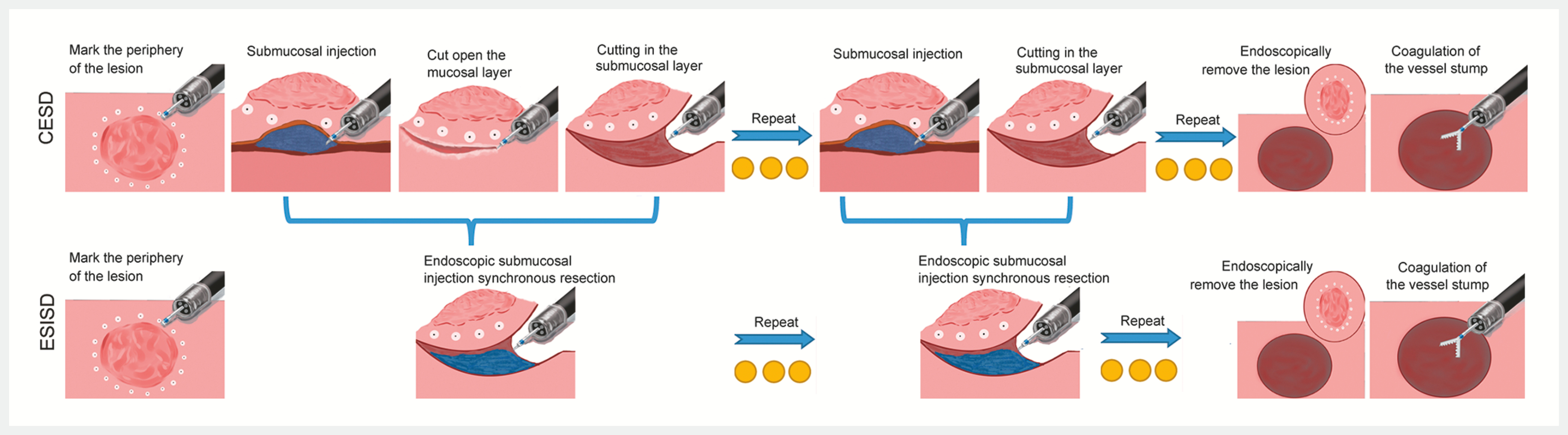
ESD provides a minimally invasive approach for the curative treatment of benign, precancerous, and early neoplastic lesions in the gastrointestinal tract [1]. In CESD, submucosal injection creates a “fluid cushion” that separates the mucosal layer from the muscularis propria, thereby reducing perforation risks [2]. However, rapid absorption of normal saline often requires repeated injections, which can prolong the procedure time. Despite the growing use of novel submucosal injection agents, their cost-effectiveness, accessibility, and the advancement of innovative injection techniques remain critical considerations.
By contrast, ESISD eliminates the need for injection needles or specialized submucosal agents by integrating injection and dissection into a single procedure ([Fig. 2]). This approach reduces procedural costs, shortens the operation time, and enhances hemostasis during dissection. Additionally, it minimizes electrosurgical carbonization of the knife, preserving its cutting efficacy. The simplicity and broad applicability of ESISD can enhance traditional ESD workflows, warranting further validation across diverse patient populations.
Endoscopy_UCTN_Code_TTT_1AQ_2AD_3AD
Contributorsʼ Statement
Xiao-Bo Liu: Conceptualization, Data curation, Formal analysis, Funding acquisition, Writing – original draft, Writing – review & editing. Hai-Tao Shen: Data curation, Formal analysis, Investigation, Writing – original draft. Ruo-Jin Yu: Data curation, Software, Writing – original draft. Tie-Yan Wang: Conceptualization, Methodology, Resources, Visualization. Yuan-Jun Gao: Conceptualization, Project administration, Supervision, Writing – review & editing.
Conflict of Interest
The authors declare that they have no conflict of interest.
Acknowledgement
We sincerely appreciate the patient for placing their trust in our care and for participating in this study.
-
References
- 1 Ciesielski W, Klimczak T, Durczynski A. et al. Application of Endoscopic Submucosal Dissection (ESD) in Treatment of Gastrointestinal Lesions-Single Center Experience. J Laparoendosc Adv Surg Tech A 2024; 34: 622-627
- 2 Coronel E. A new kid on the “bloc”? A case for another submucosal injection agent for endoscopic resection of early gastric neoplasms. Gastrointest Endosc 2024; 100: 46-48
Correspondence
Publication History
Article published online:
08 January 2026
© 2026. The Author(s). This is an open access article published by Thieme under the terms of the Creative Commons Attribution License, permitting unrestricted use, distribution, and reproduction so long as the original work is properly cited. (https://creativecommons.org/licenses/by/4.0/).
Georg Thieme Verlag KG
Oswald-Hesse-Straße 50, 70469 Stuttgart, Germany
-
References
- 1 Ciesielski W, Klimczak T, Durczynski A. et al. Application of Endoscopic Submucosal Dissection (ESD) in Treatment of Gastrointestinal Lesions-Single Center Experience. J Laparoendosc Adv Surg Tech A 2024; 34: 622-627
- 2 Coronel E. A new kid on the “bloc”? A case for another submucosal injection agent for endoscopic resection of early gastric neoplasms. Gastrointest Endosc 2024; 100: 46-48