

Subscribe to RSS
 Download PDF

DOI: 10.1055/a-2760-9005
A helix tacking system for the management of colonic anastomotic dehiscence, after a laparoscopic left colectomy
Authors

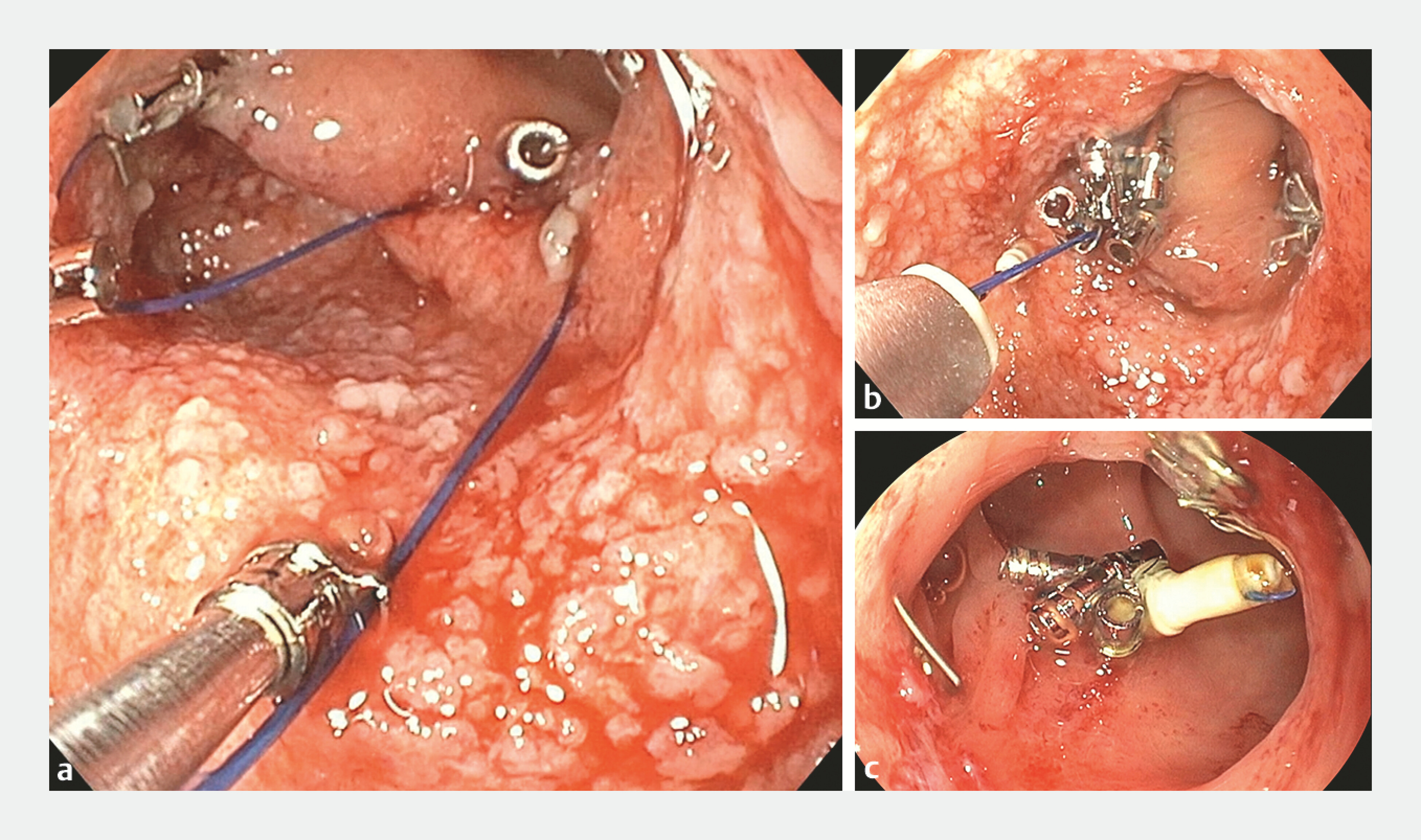
The endoscopic helix tacking system is increasingly used to treat mucosal defects, particularly following endoscopic submucosal dissection or endoscopic mucosal resection [1]. Here, we aim to demonstrate the feasibility of using this tacking system to manage an anastomotic dehiscence (AD) after oncologic laparoscopic left colectomy. AD is defined as the separation of sutures occurring within 30 days after colectomy [2]. When dehiscence leads to bowel leakage, it can result in pelvic abscesses, peritonitis, or sepsis [3]. The current standard of care includes a diverting colostomy or ileostomy along with the drainage of the surgical site infection. In recent years, however, minimally invasive endoscopic approaches, such as endoluminal vacuum therapy (EVT), have shown effectiveness in managing colonic dehiscence [2]. We present the case of a 69-year-old male patient who underwent laparoscopic left colectomy with an end-to-end colorectal anastomosis, performed 18 cm from the anal margin, to treat colonic adenocarcinoma. Within 2 months, he developed an AD affecting approximately a quarter of the anastomosis (approximately 15 mm), connected to a small cavity measuring 15–20 mm in diameter. The patient initially received EVT, which reduced the orifice size from 15 to 10 mm within 2 weeks. However, complete closure of the fistulising orifice was ultimately achieved with the use of an endoscopic helix tacking system. Closure was accomplished by placing four tacks around the defect in a “Z” pattern ([Fig. 1] and [Fig. 2] a), pulling the thread attached to the tacks, and securing the suture with a cinch device to lock the suture and cut the thread ([Fig. 2] b). Six-week follow-up confirmed successful endoscopic closure using X-MAN (heliX tacking system for the Management of colonic ANastomotic dehiscence; [Fig. 2] c). This case demonstrates the safe and effective management of post-colectomy anastomotic dehiscence using the X-MAN ([Video 1]).

Endoscopy_UCTN_Code_TTT_1AQ_2AK
Contributorsʼ Statement
Vincent VandenDriessche: Visualization, Writing – original draft, Writing – review & editing. Eda Kaya: Writing – original draft, Writing – review & editing. Patrick Yengue: Supervision. Maxence Lefebvre: Supervision.
Conflict of Interest
The authors declare that they have no conflict of interest.
-
References
- 1 Mohapatra S, Fukami N. Follow-up outcomes of mucosal defect closures after endoscopic resection using a helix tacking system and endoclips. VideoGIE 2022; 7: 268-272
- 2 Cwaliński J, Hermann J, Paszkowski J. et al. Dehiscence of colorectal anastomosis treated with non invasive procedures. Wideochir Inne Tech Maloinwazyjne 2023; 18: 128-134
- 3 Daams F, Slieker JC, Tedja A. et al. Treatment of colorectal anastomotic leakage: results of a questionnaire amongst members of the Dutch Society of Gastrointestinal Surgery. Dig Surg 2012; 29: 516-521
Correspondence
Publication History
Article published online:
08 January 2026
© 2026. The Author(s). This is an open access article published by Thieme under the terms of the Creative Commons Attribution License, permitting unrestricted use, distribution, and reproduction so long as the original work is properly cited. (https://creativecommons.org/licenses/by/4.0/).
Georg Thieme Verlag KG
Oswald-Hesse-Straße 50, 70469 Stuttgart, Germany
-
References
- 1 Mohapatra S, Fukami N. Follow-up outcomes of mucosal defect closures after endoscopic resection using a helix tacking system and endoclips. VideoGIE 2022; 7: 268-272
- 2 Cwaliński J, Hermann J, Paszkowski J. et al. Dehiscence of colorectal anastomosis treated with non invasive procedures. Wideochir Inne Tech Maloinwazyjne 2023; 18: 128-134
- 3 Daams F, Slieker JC, Tedja A. et al. Treatment of colorectal anastomotic leakage: results of a questionnaire amongst members of the Dutch Society of Gastrointestinal Surgery. Dig Surg 2012; 29: 516-521