


RSS-Feed abonnieren
 PDF herunterladen

DOI: 10.1055/s-0042-2051
Asymmetric Synthesis of 2-Arylethylamines: 2025. An Updated Review
Autor*innen
The authors gratefully acknowledge the financial support for this work provided by Ministerio de Ciencia e Innovación (PID2020-118303GB-I00 and MCIN/AEI/10.13039/501100011033), Junta de Castilla y León (SA076P20) and Universidad de Salamanca (Programme I, GIR PRONABIOLACT).

Abstract
2-Arylethylamines are present in several natural bioactive compounds, as well as in many nitrogen-containing drugs. Their ability to cross the blood–brain barrier makes this family of compounds of special interest in medicinal chemistry. Asymmetric methodologies towards the synthesis of 2-arylethylamine motifs are of significant interest due to the challenges they present. In this graphical review, we highlight recent advances in the metal-free and metal-catalyzed asymmetric synthesis of 2-arylethylamines, covering the literature published in 2025 (up until late October). We showcase the different methodologies towards the aforementioned motif, including chiral induction, organocatalysis, organophotocatalysis and enzymatic catalysis.
Key words
2-phenethylamines - 2-arylethylamines - asymmetric synthesis - chiral induction - organocatalysis - organophotocatalysis - enzymatic catalysis - metal catalysisBiosketches

Ángel García-González was born in Salamanca, Spain, and obtained his degree in chemistry (2020) and a master’s in Drug Evaluation and Development (specialization in drug design, synthesis, and evaluation) in 2021 from the Faculty of Chemical Sciences and Pharmacy, University of Salamanca, Spain. He is currently pursuing a Ph.D. in Chemical Science and Technology at the University of Salamanca under the supervision of Prof. Dr. Narciso Martín Garrido. His doctoral research, entitled ‘Synthesis of Fencamfamine and Derivatives, Molecular Modeling, and Biological Evaluation’, focuses on the synthesis and characterization of novel fencamfamine analogs and their potential pharmacological properties. He has contributed to the scientific community through publications and presentations at national and international conferences.

Narciso Martín Garrido was born in Montehermoso (Spain) and obtained his B.Sc. (1982) and his Ph.D. (1989), with an Extraordinary Award, from the University of Salamanca, Spain. Subsequently, he was a Fleming Postdoctoral Fellow at Oxford University (UK) (1990–1992) under the supervision of S. G. Davies. He returned to Salamanca as an associate professor, and then titular (1998) and currently Full Professor of Organic Chemistry since 2014. He has published more than 110 articles. In 2017, he received the María de Maeztu award for his research. He is a member of the Excellence Group of Castilla-León UIC-21 and of the Scientific Committee of ISYSYCAT (from the beginning in 2015). In addition, he is a fellow of the RSC (Royal Society of Chemistry) and the RSEQ (Real Sociedad Española de Química), and is a member of the P.N. (Produtos Naturales) and Organic Synthesis groups. He was Head of the Department of Organic Chemistry (2011–2015), director of the Nucleus Instrumental Techniques Service (2016–2018) and Vice Dean of Infrastructure and External Practices (2022–2024), and is currently the Vice Dean of Education at the Faculty of Chemical Sciences, University of Salamanca.
The 2-arylethylamine (AEA) framework represents a fundamental structural motif that is found in a wide variety of bioactive natural products and nitrogen-containing pharmaceuticals. The remarkable ability of compounds containing this framework to cross the blood–brain barrier and their affinity for dopaminergic receptors make them highly relevant in medicinal chemistry, particularly in the development of central nervous system agents. The biological activities of most of these molecules strongly depend on their absolute configuration, thus, in this context, we previously communicated the paramount importance of 2-phenethylamines[1a] and 2-heteroarylethylamines[1b] in medicinal chemistry. The enantioselective synthesis of 2-arylethylamines has become a central challenge in modern organic synthesis, where optical purity is essential for pharmaceutical applications. Additionally, we recently reviewed metal-free processes[1c] and transition-metal catalysis[1d] for the asymmetric synthesis of 2-arylethylamines.
Over recent decades, numerous strategies have been developed to achieve the asymmetric construction of the 2-arylethylamine scaffold, with two complementary approaches standing out: transition-metal-catalyzed and metal-free methodologies. Both have proven effective in introducing chirality with high precision, offering complementary advantages in terms of selectivity, substrate scope, and sustainability. Transition-metal catalysis has emerged as a powerful and versatile tool, enabling the preparation of chiral frameworks through asymmetric hydrogenations of imines and enamides, C–N cross-coupling reactions, enantioselective aziridine openings, hydroaminations, and photocatalytic processes. Metals such as copper, rhodium, ruthenium, palladium, nickel, and iridium have shown outstanding efficiency in affording amines with excellent yields and enantiomeric excesses, allowing access to complex molecular architectures with therapeutic potential. The use of chiral ligands has been particularly effective in controlling stereochemistry, optimizing reactivity, and enhancing selectivity through fine-tuning of the metal-centered catalytic cycles.
In parallel, metal-free approaches have gained prominence as sustainable and environmentally benign alternatives. These include methodologies based on chiral induction, organocatalysis, organophotocatalysis, and enzymatic catalysis, which rely on non-metal activation principles such as hydrogen bonding, ionic interactions, or photoinduced redox catalysis. Such strategies often operate under mild conditions, providing excellent stereocontrol with reduced environmental impact. Recent advances in enzymatic catalysis, especially using transaminases and oxidoreductases, have further expanded the synthetic toolbox, enabling the efficient and sustainable production of optically pure amines.
Overall, the integration of both catalytic paradigms defines the current landscape of asymmetric 2-arylethylamine synthesis. The combination of the precision and versatility of transition-metal catalysis with the sustainability and operational simplicity of metal-free strategies provides a comprehensive framework for the development of new methodologies aimed at producing enantioenriched compounds of significant pharmaceutical and chemical relevance.
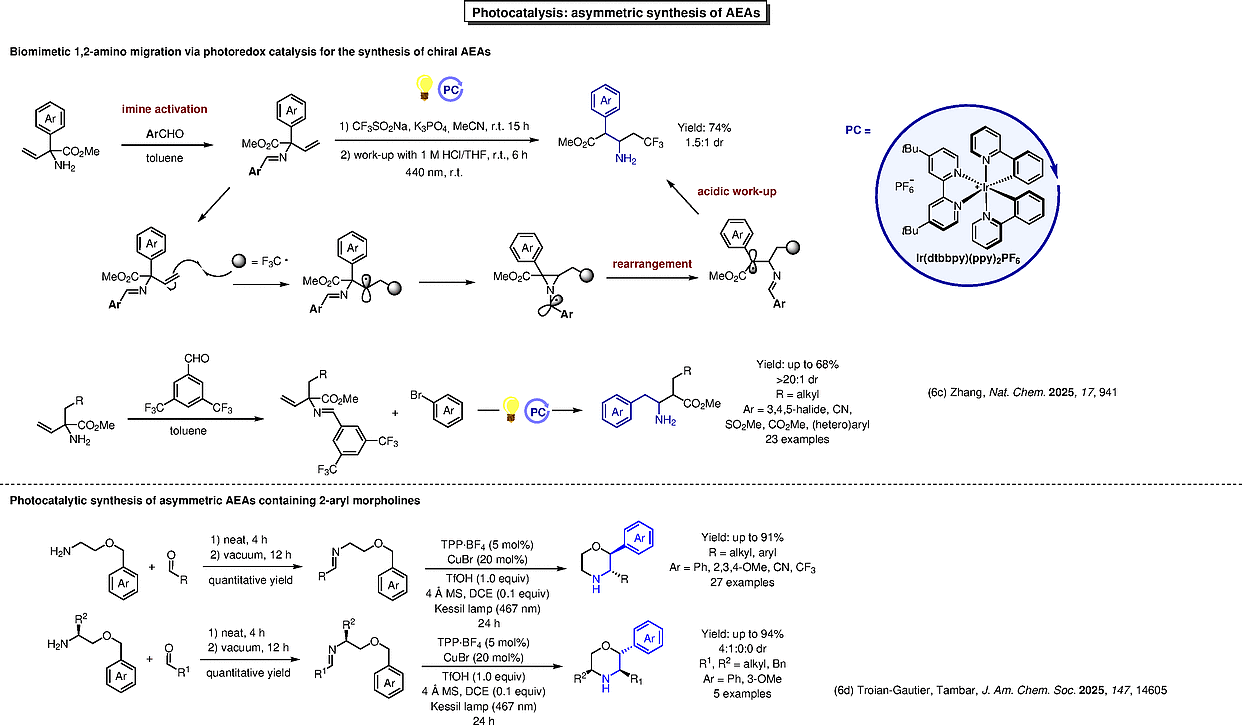
In this graphical review, we showcase the most salient methods for the asymmetric synthesis of AEAs published in 2025 (up until late October), highlighting the current state of the art for the construction of this architecture. It is hoped that this review will provide fundamental support to the scientific community involved in research on the asymmetric synthesis AEAs.


Conflict of Interest
The authors declare no conflict of interest.
-
References
- 1a Nieto CT, Manchado A, Belda L, Diez D, Garrido NM. Molecules 2023; 28: 855
- 1b Nieto C, Manchado A, García-González Á, Díez D, Garrido NM. Beilstein J. Org. Chem. 2024; 20: 1880
- 1c Manchado A, García-González Á, Nieto CT, Díez D, Garrido NM. Molecules 2024; 29: 5729
- 1d Manchado A, García-González Á, Nieto CT, Ledesma NG, Díez D, Garrido NM. Molecules 2025; 30: 1721
- 2a Polyakov VS, Barashkin AA, Grishin YK, Tarasenko EA, Beloglazkina EK. ChemistrySelect 2025; 10: e01276
- 2b Liu TF, Hang M, Lu CD. J. Org. Chem. 2025; 90: 7290
- 2c Bielecki M, Nassir M, Sharma HA, Truax NJ, Raheja N, Thompson TM, El-Hayek Ewing T, Melillo B, Cravatt BF, Baran PS. J. Am. Chem. Soc. 2025; 147: 22209
- 2d Sadanande MV, Thorat SS, Sharma H, Singh G, Vanka K, Gonnade RG, Kontham R. Chem. Asian J. 2025; 20: e202401223
- 3a Xuan T, Pan Y, Shi Z, Wang Y. Chin. Chem. Lett. 2025; 36: 110352
- 3b Reinhard DL, Iniutina A, Reese S, Shaw T, Merten C, List B, Huber SM. J. Am. Chem. Soc. 2025; 147: 8107
- 4a Lyu X, Jeon E, Seo C, Kim D, Chang S. J. Am. Chem. Soc. 2025; 147: 8928
- 4b Wu H.-Y, Koh MJ, Wang Z.-C, Shi S.-L. Angew. Chem. Int. Ed. 2025; 64: e202503126
- 4c Mellado-Hidalgo M, Conejos-Jalencas J, Teloxa SF, Suárez-Herrera A, McCall L, Costa AM, Romea P, Urpí F, Aullón G, Puigjaner C. J. Org. Chem. 2025; 90: 8519
- 4d Sun J, He J, Massaro L, Cagan DA, Tsien J, Wang Y, Attard FC, Smith JE, Lee JS, Kawamata Y, Baran PS. Nature 2025; 642: 85
- 4e Hilton TA, Richardson TM, McKay AP, Watson AJ. B. J. Org. Chem. 2025; 90: 13774
- 4f Teng F, Li ZQ, Mao ZC, Zhang Z, Jiang M, Xiao WJ, Chen JR. J. Am. Chem. Soc. 2025; 147: 19400
- 4g Garai B, Ali MR, Premkumar JR, Sundararaju B. Commun. Chem. 2025; 8: 198
- 4h Fan QK, Bai ZQ, He G, Chen G, Wang H. J. Am. Chem. Soc. 2025; 147: 20680
- 4i Mauldin D, Nguyen H, Brubaker E, Mattejat M, Franzese G, Hamerski C, Morgan JB. J. Org. Chem. 2025; 90: 9280
- 4j Daghmoum M, Sabat N, Lecoq M, Viraize T, Guinchard X. ACS Catal. 2025; 15: 2484
- 5a Kong W, Zhang J, Zhou L, Liu G, He Y, Ma L, Hollmann F, Wang L, Liu Y, Jiang Y. ACS Catal. 2025; 15: 34
- 5b Zhang H, Zhang Y, Zhu C, Deng Z, Ji L, Yin D, Liu C, Luo Z, Yuan Z, Rao Y. ACS Catal. 2025; 15: 5426
- 5c Jia D.-X, Zang L, Ni C.-D, Wang J.-L, Yu H, Liu Z.-Q, Zheng Y.-G. Biotechnol. Bioeng. 2025; 122: 1735
- 5d Lei B, Jiang W, Ma J, Wang C, Pan Y, Zhang Z, Wang B, Guo J, Qi N. Biotechnol. Lett. 2025; 47: 11
- 6a Paulus F, Heusel C, Jaspers M, Amrehn LM, Schreiner F, Rana D, Daniliuc CG, Hansen MR, Glorius F. Angew. Chem. Int. Ed. 2025; 64: e202504793
- 6b Barney JL, Wolfram AJ, Litvak R, Nacsa ED. ACS Catal. 2025; 15: 2139
- 6c Fan W, Cui Y, Zhan B, Chen Y, Bao L, Liang Y, Zhang X. Nat. Chem. 2025; 17: 941
- 6d Brisco TA, De Kreijger S, Nair VN, Troian-Gautier L, Tambar UK. J. Am. Chem. Soc. 2025; 147: 14605
Corresponding Author
Publikationsverlauf
Eingereicht: 27. Oktober 2025
Angenommen nach Revision: 03. Dezember 2025
Artikel online veröffentlicht:
18. Dezember 2025
© 2025. The Author(s). This is an open access article published by Thieme under the terms of the Creative Commons Attribution License, permitting copying and reproduction so long as the original work is given appropriate credit. Contents may not be used for commercial purposes or adapted, remixed, transformed or built upon. (https://creativecommons.org/licenses/by/4.0/)
Georg Thieme Verlag KG
Oswald-Hesse-Straße 50, 70469 Stuttgart, Germany
-
References
- 1a Nieto CT, Manchado A, Belda L, Diez D, Garrido NM. Molecules 2023; 28: 855
- 1b Nieto C, Manchado A, García-González Á, Díez D, Garrido NM. Beilstein J. Org. Chem. 2024; 20: 1880
- 1c Manchado A, García-González Á, Nieto CT, Díez D, Garrido NM. Molecules 2024; 29: 5729
- 1d Manchado A, García-González Á, Nieto CT, Ledesma NG, Díez D, Garrido NM. Molecules 2025; 30: 1721
- 2a Polyakov VS, Barashkin AA, Grishin YK, Tarasenko EA, Beloglazkina EK. ChemistrySelect 2025; 10: e01276
- 2b Liu TF, Hang M, Lu CD. J. Org. Chem. 2025; 90: 7290
- 2c Bielecki M, Nassir M, Sharma HA, Truax NJ, Raheja N, Thompson TM, El-Hayek Ewing T, Melillo B, Cravatt BF, Baran PS. J. Am. Chem. Soc. 2025; 147: 22209
- 2d Sadanande MV, Thorat SS, Sharma H, Singh G, Vanka K, Gonnade RG, Kontham R. Chem. Asian J. 2025; 20: e202401223
- 3a Xuan T, Pan Y, Shi Z, Wang Y. Chin. Chem. Lett. 2025; 36: 110352
- 3b Reinhard DL, Iniutina A, Reese S, Shaw T, Merten C, List B, Huber SM. J. Am. Chem. Soc. 2025; 147: 8107
- 4a Lyu X, Jeon E, Seo C, Kim D, Chang S. J. Am. Chem. Soc. 2025; 147: 8928
- 4b Wu H.-Y, Koh MJ, Wang Z.-C, Shi S.-L. Angew. Chem. Int. Ed. 2025; 64: e202503126
- 4c Mellado-Hidalgo M, Conejos-Jalencas J, Teloxa SF, Suárez-Herrera A, McCall L, Costa AM, Romea P, Urpí F, Aullón G, Puigjaner C. J. Org. Chem. 2025; 90: 8519
- 4d Sun J, He J, Massaro L, Cagan DA, Tsien J, Wang Y, Attard FC, Smith JE, Lee JS, Kawamata Y, Baran PS. Nature 2025; 642: 85
- 4e Hilton TA, Richardson TM, McKay AP, Watson AJ. B. J. Org. Chem. 2025; 90: 13774
- 4f Teng F, Li ZQ, Mao ZC, Zhang Z, Jiang M, Xiao WJ, Chen JR. J. Am. Chem. Soc. 2025; 147: 19400
- 4g Garai B, Ali MR, Premkumar JR, Sundararaju B. Commun. Chem. 2025; 8: 198
- 4h Fan QK, Bai ZQ, He G, Chen G, Wang H. J. Am. Chem. Soc. 2025; 147: 20680
- 4i Mauldin D, Nguyen H, Brubaker E, Mattejat M, Franzese G, Hamerski C, Morgan JB. J. Org. Chem. 2025; 90: 9280
- 4j Daghmoum M, Sabat N, Lecoq M, Viraize T, Guinchard X. ACS Catal. 2025; 15: 2484
- 5a Kong W, Zhang J, Zhou L, Liu G, He Y, Ma L, Hollmann F, Wang L, Liu Y, Jiang Y. ACS Catal. 2025; 15: 34
- 5b Zhang H, Zhang Y, Zhu C, Deng Z, Ji L, Yin D, Liu C, Luo Z, Yuan Z, Rao Y. ACS Catal. 2025; 15: 5426
- 5c Jia D.-X, Zang L, Ni C.-D, Wang J.-L, Yu H, Liu Z.-Q, Zheng Y.-G. Biotechnol. Bioeng. 2025; 122: 1735
- 5d Lei B, Jiang W, Ma J, Wang C, Pan Y, Zhang Z, Wang B, Guo J, Qi N. Biotechnol. Lett. 2025; 47: 11
- 6a Paulus F, Heusel C, Jaspers M, Amrehn LM, Schreiner F, Rana D, Daniliuc CG, Hansen MR, Glorius F. Angew. Chem. Int. Ed. 2025; 64: e202504793
- 6b Barney JL, Wolfram AJ, Litvak R, Nacsa ED. ACS Catal. 2025; 15: 2139
- 6c Fan W, Cui Y, Zhan B, Chen Y, Bao L, Liang Y, Zhang X. Nat. Chem. 2025; 17: 941
- 6d Brisco TA, De Kreijger S, Nair VN, Troian-Gautier L, Tambar UK. J. Am. Chem. Soc. 2025; 147: 14605